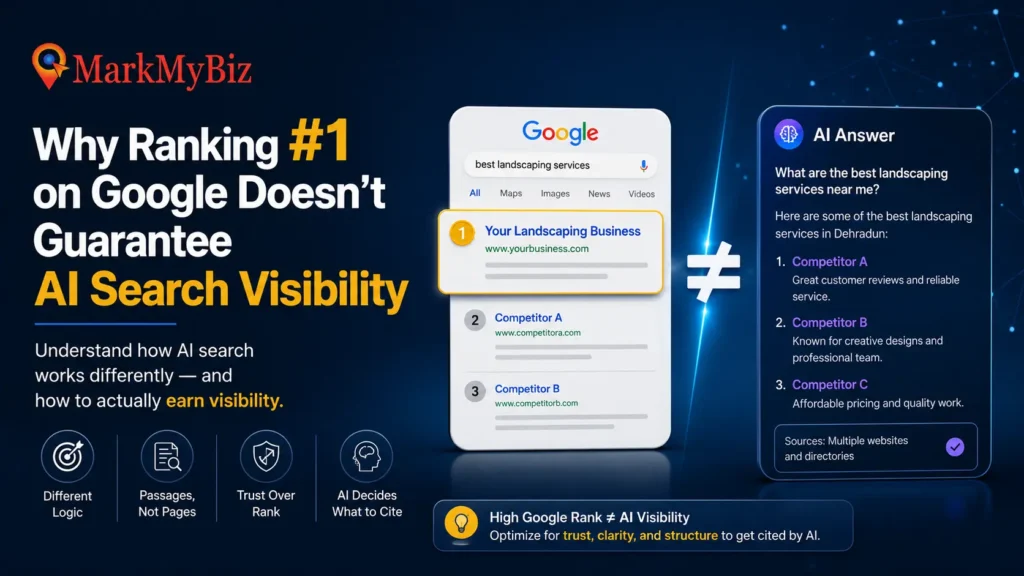
Type a question into Perplexity or ChatGPT and you get one paragraph back, built from a handful of sources, with everything else quietly left out. A physiotherapy clinic in Dehradun that ranks on page one of Google for “physiotherapy near me” can ask that same question in ChatGPT and find three competitors named instead — none ranked higher on Google, all somehow chosen for the answer.
That gap is becoming normal. Search used to mean handing someone ten links and letting them pick. A growing share of searches now hand back one written answer instead, assembled by a model that decided, on its own, which sources were worth quoting. Ranking well still matters; it just isn’t the only test anymore.
Generative Engine Optimization (GEO) is the practice built around that second test: getting a business named, quoted, or recommended inside an AI-generated answer.
What Is Generative Engine Optimization?
Generative Engine Optimization is the practice of shaping content, entity signals, and technical SEO so that generative AI systems — ChatGPT, Gemini, Perplexity, and Google’s AI Overviews and AI Mode — are more likely to cite, quote, or recommend a business when answering a related question. The term comes from a specific piece of research: Aggarwal and coauthors formalized it in a paper accepted to KDD 2024, the ACM’s data mining conference, defining a “generative engine” as a system that retrieves relevant documents and uses a language model to write one grounded answer, instead of returning a ranked list of pages. Some people write about the same practice as AI search optimization, generative search optimization, or simply AI SEO — the label matters less than the underlying work.
That retrieve-then-generate structure is why GEO isn’t “SEO with different keywords.” A traditional search engine only has to decide whether a page is relevant enough to include in a results list. A generative engine has to decide whether a source is trustworthy enough to build an answer around, and whether to name it at all when it does. GEO is the set of practices aimed at improving the odds of that second decision.
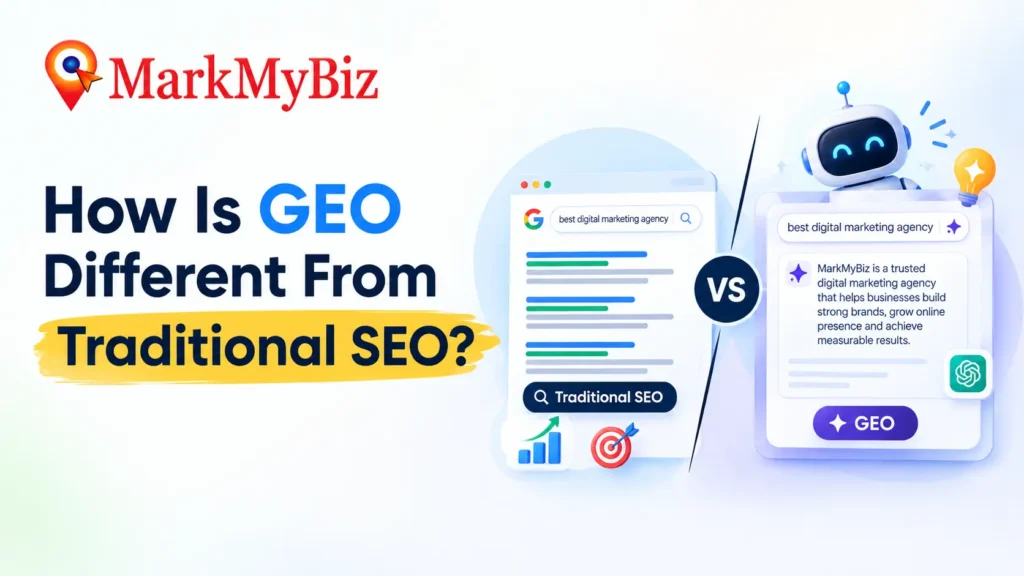
How Is GEO Different From Traditional SEO?
| SEO | GEO | |
|---|---|---|
| Primary objective | Rank as high as possible for a query | Get cited, quoted, or named inside a generated answer |
| Visibility format | A ranked list of links | One synthesized answer, sometimes with a short source list |
| Typical signals | Keywords, backlinks, technical health, authority | Verifiable facts, entity consistency, extractable structure, corroboration |
| Common metrics | Rankings, organic traffic, click-through rate | Citation frequency, mention share, presence inside AI answers |
| User experience | Browse and compare several options | Read one answer, click through only if curious |
The two aren’t rivals. A generative engine still has to find and trust a page before it can quote from it, and most of that discovery runs through the same crawling, indexing, and authority signals that power conventional search. Google’s own developer documentation is direct about this: it states there are no additional requirements to appear in AI Overviews or AI Mode beyond the standard SEO fundamentals.
Laid out as a chain, it looks like this: SEO earns crawlability and relevance, semantic and entity SEO teach a system who you are, topical authority earns trust across a subject, and all of that together is what determines whether AI search treats a source as citation-worthy — the moment that eventually shows up as AI visibility in a business’s own traffic or reputation. SEO gets a page into consideration. GEO is what happens after that.
How AI Search Systems Find and Use Information
Every generative engine runs some version of the same basic loop, even though the details differ system to system. A query comes in, and the system resolves it into intent — sometimes several sub-questions, if the tool uses “query fan-out,” Google’s term for issuing multiple related searches to cover a topic from more than one angle. It retrieves candidate documents from an index or a live crawl, screens them for relevance and trustworthiness, and passes the strongest few to a language model, which writes one answer grounded in what it retrieved.
Two things fall out of that loop that matter for a business. First, accessibility comes before everything else — if a system can’t crawl, render, or understand a page, nothing else here matters. Second, the system isn’t only checking whether a page is relevant; it’s checking whether the source, and the entity behind it, is one it already has reason to trust. That’s where brand and entity signals come in: consistent, verifiable facts about who a business is carry weight a keyword-optimized page alone doesn’t.
Not every system works identically. ChatGPT, Gemini, Perplexity, and Google’s AI Overviews pull from different indexes, use different retrieval methods, and show citations differently — Perplexity and ChatGPT search typically link sources, while some voice and chat surfaces show none at all. Asking specifically about “ChatGPT and Gemini optimization” usually points to the same underlying work described here; the tools differ, the signals they weigh don’t.
Traditional Search vs. GEO, as a Funnel
Traditional SEO: Ranking → Impression → Click → Website
GEO: Query → Retrieval → Source Selection → Generated Answer → Mention or Citation → Possible Visit
The GEO funnel has an extra filter traditional SEO never had to clear — source selection — and the last step is optional rather than expected. Being mentioned doesn’t guarantee a click the way ranking third on Google generally still does.
There’s real data behind why that filter matters. In the research that formalized GEO, Aggarwal and coauthors tested nine content changes against a 10,000-query benchmark (GEO-bench) and found that adding verifiable statistics, credible quotations, and citations to reliable sources produced the largest gains in citation likelihood, on the order of 30–40% by their measure, while fluency and readability improvements added a further 15–30%. Keyword density, the classic SEO lever, moved the needle only marginally. Source: Aggarwal et al., “GEO: Generative Engine Optimization,” KDD 2024 — a controlled benchmark study, not a live measurement of any single commercial AI product, so treat the percentages as directional rather than universal.
Practical GEO Strategies for Better AI Search Visibility
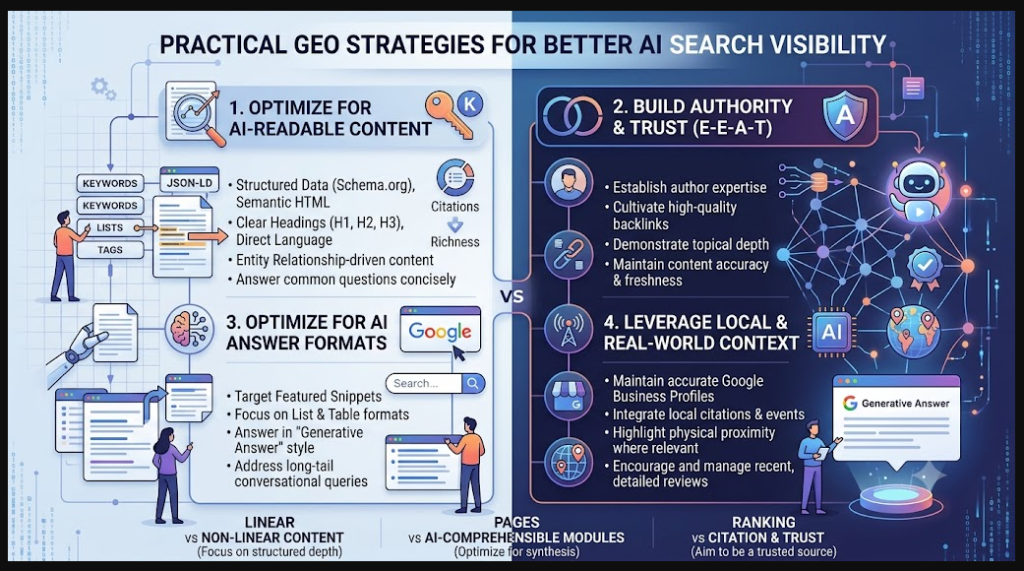
The strategies below cover content optimization for AI search across the levers a business actually controls, from what to write to how to structure and measure it.
1. Build authoritative, answer-focused content
Answer the question a heading asks, in the first sentence or two, then explain. A model scores passages partly on how directly they resolve a query, so burying the answer under three paragraphs of setup means it may move on before finding it. An ed-tech business in Dehradun opening with “NEET coaching in Dehradun typically runs ₹40,000–₹1,20,000 a year, depending on batch size” gets quoted more often than one that opens with a paragraph about the value of quality education.
2. Demonstrate first-hand expertise
Generic advice like “create high-quality content” doesn’t give a model anything to verify. Specific, checkable detail does — a number, a named example, a result described honestly. Google’s own E-E-A-T guidance singles out first-hand experience as the hardest signal for a competitor to fake, which is exactly why it carries weight with generative engines too. A furniture workshop describing how it actually kiln-dries wood gives a model something concrete to repeat, unlike a vague claim about “premium materials.”
3. Strengthen brand and entity signals
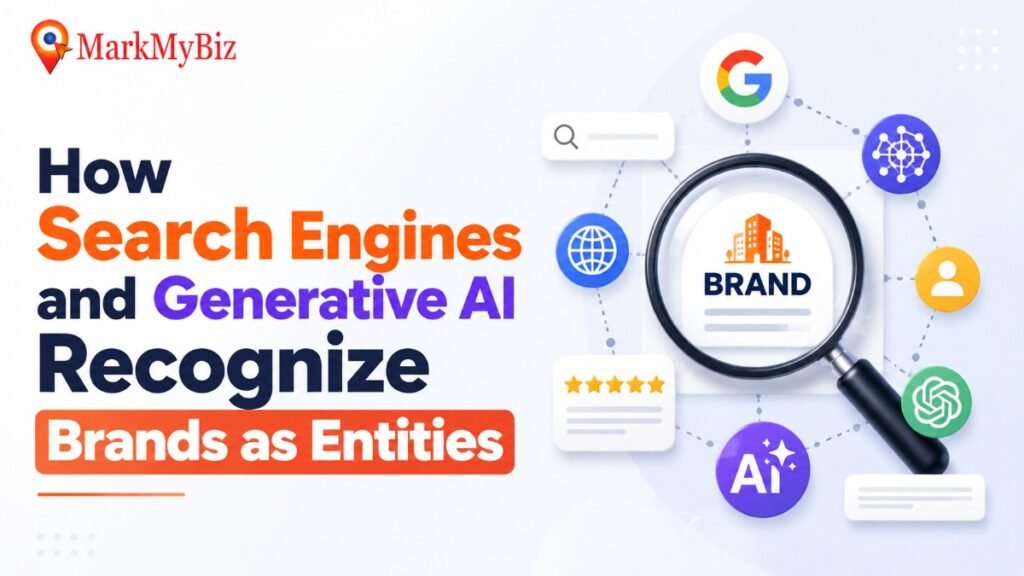
A generative engine has to decide who you are before it decides to trust you. The same name, address, services, and founding details need to match across your website, Google Business Profile, and any directory that mentions you. Inconsistency doesn’t usually get penalized so much as ignored — an unclear entity is simply harder to cite with confidence. MarkMyBiz’s guide to brand entity SEO covers how that recognition actually works.
4. Build topical authority
A single well-written page rarely earns much trust on its own. A connected cluster — a pillar guide linked to supporting articles on related subtopics — signals that a site genuinely knows a subject, rather than having written about it once. This is one of the areas where SEO and GEO overlap completely: topical depth helps rankings and citation odds for the same underlying reason.
5. Make important information easy to extract and understand
Short paragraphs, headings phrased the way people actually ask questions, and lists or tables where they genuinely help all make a passage easier to lift cleanly. A wall of unbroken text forces a model to do more interpretive work, and it will often pick a page that required less.
6. Maintain consistent business information
Name, address, phone, and service descriptions should read identically everywhere — website, Google Business Profile, directories, review platforms. This is standard local SEO practice, and it does double duty for GEO: consistency is one of the clearest signals a generative engine can use to confirm an entity is real, rather than piecing together fragments and giving up.
7. Strengthen relevant third-party mentions and references
Independent coverage — press, directories, industry publications, genuine reviews — matters more to generative engines than to traditional rankings, because it’s corroboration the model didn’t get from the business itself. A single glowing paragraph on your own site carries less weight than three unrelated sources agreeing on the same fact.
8. Maintain technical SEO fundamentals
None of the above works if a system can’t crawl, render, or index the page in the first place. Clean site architecture, fast load times, and no accidental noindex tags remain the floor, not an optional extra — and that now includes staying reachable to AI crawlers specifically, not just Googlebot.
9. Use structured data appropriately
Schema markup — Article, FAQPage, Organization, LocalBusiness — gives a machine explicit, labeled facts instead of ones it has to infer from prose. It isn’t a guaranteed citation factor by itself, but it removes ambiguity a model would otherwise have to resolve on its own. MarkMyBiz’s look at schema markup and AI citations goes into what actually moves the needle here.
10. Measure AI visibility instead of assuming success
Rank trackers don’t see citations inside ChatGPT or Perplexity. Measuring GEO progress means actually asking the tools the questions customers would ask, noting whether and how a business gets named, and repeating that check periodically, since answers shift as models update. MarkMyBiz’s guide to measuring AI search performance walks through a fuller version of that process.
GEO Strategy vs. Business Benefit
| GEO strategy | What it improves | Practical implementation |
|---|---|---|
| Answer-focused content | Information clarity | Answer the question in the opening sentence |
| Entity consistency | Brand understanding | Match business details everywhere they appear |
| Topical authority | Contextual relevance | Build connected content clusters, not isolated pages |
| First-hand expertise | Trust | Use specific, checkable detail over generic claims |
| Structured data | Machine-readable context | Add appropriate schema (Article, FAQPage, LocalBusiness) |
| External mentions | Authority signals | Earn genuine third-party coverage and reviews |
| Technical accessibility | Discoverability | Keep pages crawlable, fast, and properly indexed |
When GEO Needs Professional Help
Most of the list above is doable in-house for a business with one or two core pages to fix. Formal AI search optimization services tend to make more sense once entity consistency has to be checked across a dozen directory listings, schema needs implementing site-wide rather than on one page, or nobody in-house has time to check ChatGPT, Perplexity, and AI Overviews on a regular schedule.
GEO services for small businesses, and for Indian businesses specifically, tend to start from the same groundwork as local SEO — consistent business details, a complete Google Business Profile, genuine reviews — before layering in content restructuring and schema. MarkMyBiz works with businesses on that combination in practice, functioning as a GEO agency in Dehradun by folding entity consistency and AI-visibility checks into the same SEO agency in Dehradun work already underway for traditional rankings, rather than selling GEO as a separate line item.
FAQs
What is Generative Engine Optimization?
GEO is the practice of structuring content, entity signals, and technical SEO so that generative AI systems — ChatGPT, Gemini, Perplexity, and Google’s AI Overviews — are more likely to cite or recommend a business, rather than just ranking its page in a results list.
How is GEO different from SEO?
SEO gets a page into consideration through relevance, authority, and technical health. GEO is what happens after that: whether a generative system trusts the page enough to quote it or build part of its answer around it. The two overlap heavily and rarely work as separate projects.
Does SEO help GEO?
Yes. Google’s own guidance states that standard SEO fundamentals are what surface content in AI Overviews and AI Mode, with no separate checklist required. A page still needs to be crawlable, relevant, and authoritative before entity consistency or structured data can do any good.
Can small businesses benefit from GEO?
Often more easily than large ones. Generative engines reward consistent, verifiable facts more than sheer content volume — something a small business with clean, accurate information can compete on more readily than it can compete on backlink count.
What’s the difference between GEO and AEO?
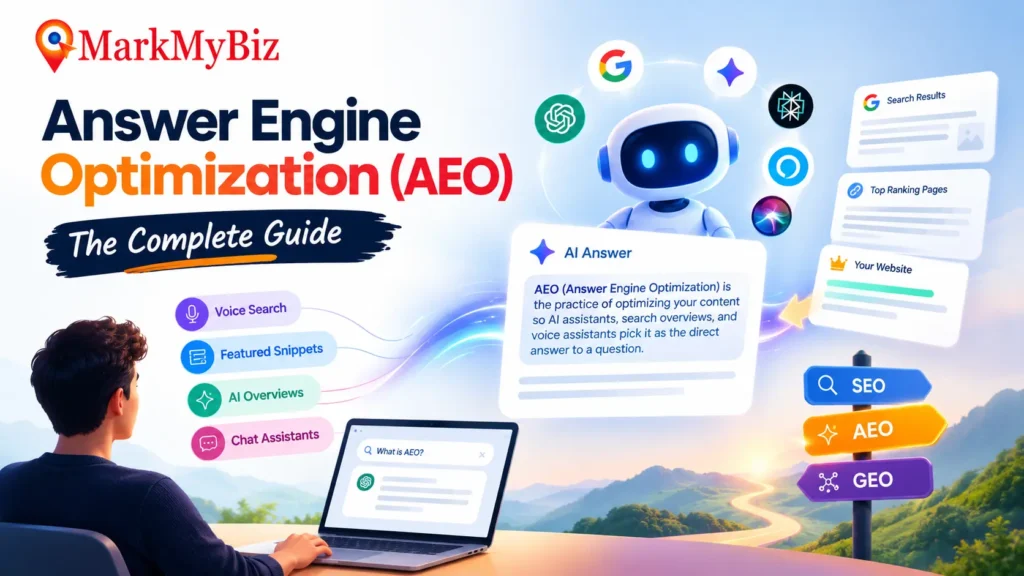
The two overlap almost entirely. AEO covers every surface that returns a single answer, including featured snippets and voice assistants; GEO focuses specifically on tools that generate a written answer, like ChatGPT and Perplexity. MarkMyBiz’s AEO guide goes deeper into that distinction.
How long does GEO take to show results?
Structural fixes — schema, answer-first formatting, consistent business details — can show up within weeks. Being reliably cited inside AI tools tends to build over a few months, similar to how backlink-driven authority builds in traditional SEO. No legitimate approach can guarantee a citation for a specific query.
Trusted Sources & References
- Aggarwal, P., Murahari, V., Rajpurohit, T., Kalyan, A., Narasimhan, K., & Deshpande, A. (2024).
GEO: Generative Engine Optimization. Proceedings of the 30th ACM SIGKDD Conference on Knowledge Discovery and Data Mining (KDD ’24).
DOI: 10.1145/3637528.3671900
Used for: The foundational GEO research, GEO-bench benchmark, and findings regarding content interventions and generative-engine visibility. - Google Search Central.
AI features and your website.
Google Search Central — AI features and your website
Used for: Google’s official guidance on AI Overviews and AI Mode, including the statement that there are no additional technical requirements beyond standard SEO fundamentals. - Google Search Central.
Structured data general guidelines.
Google Search Central — Structured data general guidelines
Used for: Structured-data implementation principles and Google’s guidelines for using structured data appropriately. - Schema.org.
Schema.org Vocabulary.
Schema.org
Used for: The canonical vocabulary and definitions for schema types referenced in this guide, including Article, FAQPage, Organization, and LocalBusiness.