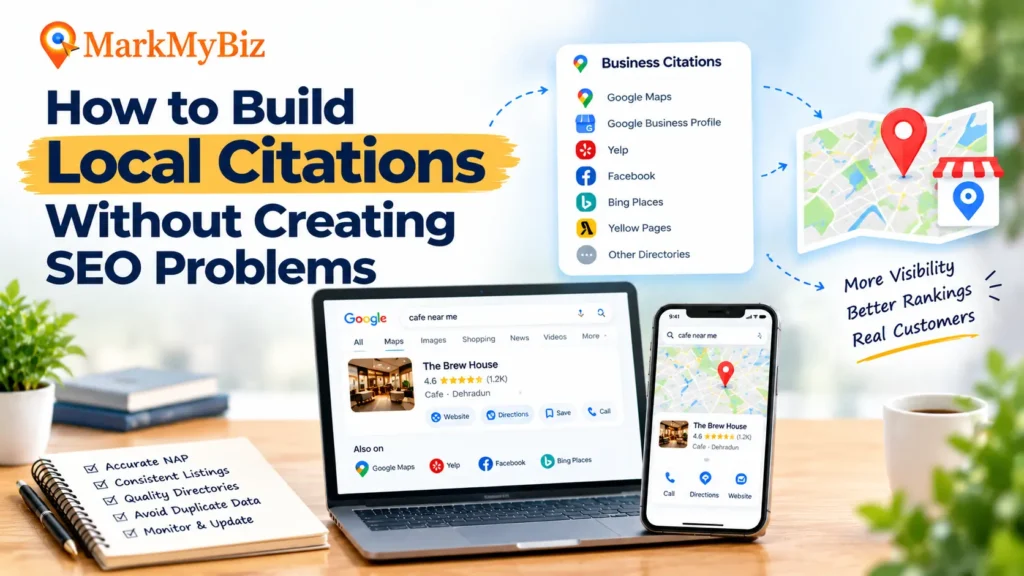
Most businesses that get hurt by citations didn’t skip citation building. They did it badly.
Somebody hands the job to an intern, or buys a cheap bulk-submission package, or an old marketing agency leaves listings behind after the contract ends, and eighteen months later there are three versions of the business floating around the internet with three different phone numbers. Nobody did anything maliciously. It just accumulated.
Local citations building is genuinely useful when it’s done with care. It’s genuinely damaging when it’s rushed. This guide is the version of the process that avoids the second outcome — a practical, no-nonsense approach to building local citations without creating the SEO problems that end up costing more to fix than the original work was worth.
| About This Guide: Written by the MarkMyBiz team — a Dehradun-based digital marketing and local SEO agency that runs citation audits and cleanups for businesses across Uttarakhand and North India. This is the process we actually use, not a theoretical checklist. |
Before You Build Anything, Audit What Already Exists
The single most common mistake in local citations building is starting fresh without checking what’s already out there.
Almost every business older than a couple of years has some citation debt sitting around — an old agency’s zombie listing that never got deactivated, a duplicate a well-meaning employee created because they didn’t see the first one, or a profile a data aggregator auto-generated from public records years ago. Building new, correct citations on top of that doesn’t fix anything. It adds a fourth version of the truth to the three that already confuse things.
Spend thirty minutes before you do anything else. Search your business name in quotes, and search it again with your city added. Open everything that comes back. Note which ones are accurate, which are outdated, and which are outright duplicates. This single step prevents most of the damage covered in the rest of this guide.
Keep a simple record as you go — platform, current status, what needs fixing. It sounds unnecessary for a handful of listings and becomes essential the moment you’re managing twenty. Local SEO citations have a way of multiplying quietly; a record stops the next audit from starting at zero.
Lock Down One Canonical NAP Before You Start
NAP consistency isn’t a nice-to-have here — it’s the entire foundation citations for local SEO are built on.
Before creating or updating a single listing, write down the exact version of your business name, address, and phone number you’re going to use everywhere. Not close enough. Character for character. Suite versus Ste. Road versus Rd. The phone number with the country code formatted the same way every time.
Use your real, legal or trading business name — nothing added. “MarkMyBiz” is a citation. “MarkMyBiz — Best Digital Marketing Agency in Dehradun” is a guideline violation waiting to get a listing suspended, and it also breaks NAP consistency the moment one directory has the clean version and another has the keyword-stuffed one. Google and most platforms treat that as two different entities, not clever optimization.
Keep this master record somewhere your whole team can see it — a shared sheet works fine. Every listing gets built from that one document, never from memory.
Start With Google Business Profile, Then Branch Out
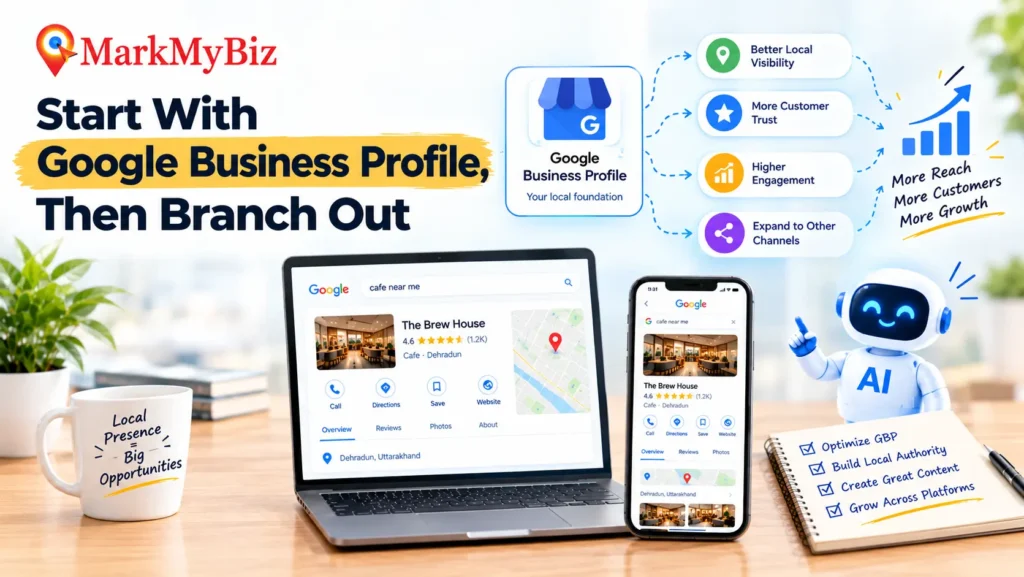
Get your Google Business Profile fully accurate before spending a single hour on directories. Google Business Profile optimization isn’t just one citation among many — it’s the reference point everything else gets measured against, by Google, by other platforms, and increasingly by AI systems checking your details before naming you in an answer.
Fill in every field: categories, service areas, hours, attributes, a real description. GBP optimization done properly here saves rework later, because directory listings that disagree with your profile are what create the inconsistency problem in the first place.
Once that’s locked, move outward — the major platforms, then the ones specific to your industry and city.
Choose Platforms Deliberately, Not by Volume
More citations is not the goal. Relevant, accurate citations on platforms that carry weight for your city and category is the goal.
For most local SEO for businesses operating in India, that shortlist looks like: Google Business Profile, Bing Places, Justdial, Sulekha and IndiaMART, plus whichever vertical platform fits — Practo for healthcare, an education portal for institutes, a property platform for real estate. Add two or three genuinely relevant local or trade directories your customers might actually browse.
That’s it for most businesses. Fifteen to twenty accurate listings on platforms that matter does more for local citations for business visibility than two hundred scattered across sites nobody visits. Every listing beyond what’s relevant is one more place your data can go stale without anyone noticing.
The Mistakes That Turn Citations Into a Liability
This is the part that actually creates the problems in this guide’s title, so it’s worth being specific.
Duplicate listings top the list. Two profiles for the same business split your reviews, confuse Google about which one is authoritative, and in Google’s own local results can meaningfully hurt your odds of appearing in the top results. They happen most often after a rebrand, an address change, or when a new employee creates a listing without checking if one already exists. Merge or remove duplicates as soon as you spot them — don’t leave the older, thinner one sitting there.
Keyword-stuffed names are next, and they’re a guideline violation on almost every platform, Google included. It reads as spam, it looks unprofessional to customers, and it fragments your citation strength because now your “keyword name” and your real name are technically different entities to a machine.
Choosing the broadest category instead of the most accurate one seems harmless. It isn’t — it puts you in front of searches you can’t actually fulfil, which shows up in poor engagement signals over time.
Skipping optional fields is a smaller mistake with a similar effect. A half-filled listing gives search engines and AI systems less to corroborate against, so it does less work than a complete one even when everything it does contain is accurate. Filling in a description, hours and a website link takes minutes and meaningfully strengthens what a thin listing was already trying to do.
Bulk automated submission tools are worth naming directly, because they’re marketed as a shortcut and they’re usually where the real damage starts. These tools push your details to hundreds of directories at once, often getting formatting slightly wrong on a chunk of them, and untangling a hundred auto-generated errors later costs far more than doing fifty listings manually would have. If a citation-building service can’t tell you exactly which platforms they submit to, that’s a reasonable reason to say no.
And the quiet one: set-it-and-forget-it. Citations aren’t a one-time task. Addresses change, phone numbers get reassigned, aggregators occasionally resurrect old data. A listing that was correct two years ago isn’t guaranteed to still be correct today.
One more worth a mention: call-tracking numbers. Swapping your listed number for a dynamic tracking number might help with attribution, but if that number differs from what’s on your website and your other citations, you’ve just manufactured the exact inconsistency this whole guide is trying to prevent. Keep one permanent number on every citation and track calls a different way if you need the data.
A Build Process That Doesn’t Backfire
Once the audit is done and the master NAP record exists, the actual building is straightforward.
- Fix what the audit found first — merge duplicates, correct outdated listings, claim anything unclaimed. Cleaning up existing damage matters more than adding anything new.
- Finish Google Business Profile optimization completely before moving to directories.
- Manually claim and complete the five to ten platforms that genuinely matter for your city and category, copying every field from your master NAP record.
- Add a small number of niche or local directories relevant to your specific industry, rather than chasing every general directory that exists.
- Skip bulk automated tools for anything tied to your core business identity. They’re occasionally fine for low-stakes, low-visibility platforms — never for Google, Bing, or your top five.
- Set a quarterly reminder to recheck your top listings. This is the step almost everyone skips, and it’s the reason citation debt builds back up.
Why This Also Matters for AI Search
Clean, consistent citations don’t just help traditional rankings. Local citations for AI search work the same way — AI systems cross-check several sources before describing your business confidently, and conflicting data is one of the more common reasons a business gets quietly skipped in favour of a competitor whose details line up. Getting the building process right the first time means you’re not creating the exact inconsistency that costs you visibility on both fronts at once.
Frequently Asked Questions
Is it better to have more citations or fewer, more accurate ones?
Fewer and accurate, without question. A short list of correct listings on platforms that matter outperforms a long list with even a handful of errors, because the errors are what damage trust with both search engines and customers.
Can I use an automated tool to build citations quickly?
You can, but reserve it for lower-stakes directories only. Automated bulk submission is the single most common cause of the NAP inconsistency that undoes citation building. Anything connected to Google, Bing, or your top platforms is worth doing by hand.
How often should citations be audited?
Quarterly for most small businesses, and immediately after any address change, phone number change, or rebrand. Citation debt from unaddressed changes is far harder to untangle the longer it sits.
When It’s Worth Bringing in Help
A single-location business can usually manage this with an afternoon and the process above. Multiple locations, a recent rebrand, or a backlog of old duplicate listings changes that math quickly — untangling years of accumulated errors is genuinely tedious work.
MarkMyBiz runs local SEO service in Dehradun covering exactly this: citation audits, cleanup of duplicate and outdated listings, full Google Business Profile optimization, and ongoing monitoring so new errors don’t quietly build up again. As a local SEO agency working across AI search optimization services too, we build citations with the same discipline this guide describes — accurate first, comprehensive second.
Not sure how many versions of your business are currently floating around online? Send us your business name and city and we’ll show you what we find.