Every SEO pitch deck in 2026 has the same slide. Add JSON-LD, get cited by ChatGPT. It’s a clean story. It’s also, at best, half true.
Here’s the honest answer: schema markup and AI citations are correlated. That correlation is not causal, and the gap between those two facts has already cost businesses real budget.
The short version of the debate around structured data and AI citations: schema helps machines parse your page, but it doesn’t reliably move the needle on whether that page gets quoted. If you’ve been asking “does schema markup help AI citations,” this is that answer.
What Schema Markup Actually Does (And What It Doesn’t)
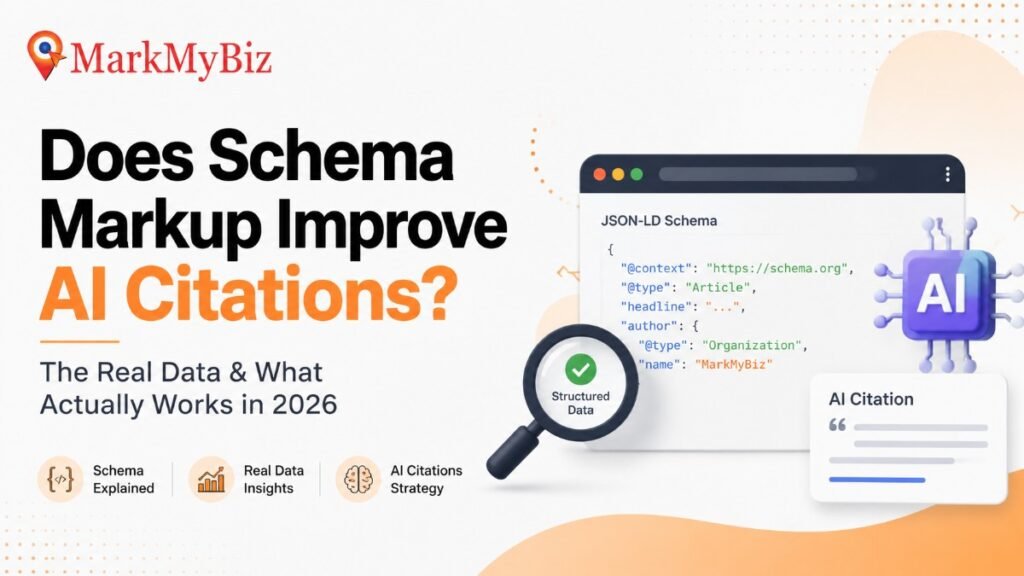
Schema markup, usually written as JSON-LD, is a structured vocabulary that tells machines what’s on a page. A Product block says “this is a product, here’s the price, here’s the rating.” An Organization block says “this entity is a company, here’s its logo, here’s its sameAs links to Wikipedia and LinkedIn.”
It doesn’t make your content better or make Google trust you more. What it does is remove ambiguity — machines don’t have to guess whether “$49” refers to a product price or a shipping fee. That’s the job.
Where this gets confused is the leap from “reduces ambiguity” to “increases citations.” Those are different claims, and the industry has been treating them as the same thing since AI Overviews launched.
Schema Markup AI Citations: The Correlation Everyone Points To
Ahrefs analyzed 6 million URLs and found that pages cited in AI answers were about three times more likely to carry JSON-LD schema markup than pages that weren’t cited — 53% versus roughly a third of that rate. That stat has been screenshotted into a thousand agency proposals as proof that structured data drives AI citations.
It’s real. It’s also the kind of number that gets people to buy the wrong thing.
Sites that bother implementing structured data correctly tend to be the same sites investing in technical SEO, content depth, and link acquisition. When you see a correlation between schema markup and AI citations, you’re mostly seeing a correlation between “sites run by competent teams” and “sites that get cited.” Schema is a symptom of quality, not a cause of it.
What Happens When You Actually Test It
Correlation studies are easy to run. Causal tests are harder, and far more useful.
What Controlled Testing Revealed
In May 2026, Ahrefs researchers Louise Linehan and Xibeijia Guan published a study that did the actual work: they tracked 1,885 pages that added JSON-LD schema markup between August 2025 and March 2026, then matched each one against roughly 4,000 similar control pages with the same starting citation levels. The only difference was the treatment.
They measured AI Overviews citations 30 days before and after schema went live, alongside Google AI Mode and ChatGPT citations. The result: AI Overview citations moved by -4.6%, AI Mode by +2.4%, ChatGPT by +2.2% — every number inside the range you’d expect from random noise across thousands of URLs.
Not a modest lift. No effect, full stop. A separate cross-platform study published on SSRN in February 2026 by Kurt Fischman reached a similar conclusion, finding JSON-LD doesn’t independently predict citation probability once other quality signals are controlled for — further evidence schema doesn’t belong near the top of your list of AI search ranking factors.
If your agency is still selling schema markup AI citations lift as a guarantee, ask where their before-and-after data is. Not a correlation chart — a matched test. Any AI SEO consultant worth the invoice can show something closer to that.
Why Organic Rankings Still Dominate AI Citations
Here’s what actually predicts citations: where you already rank.
Ahrefs’ broader research on AI Overviews citations found that 76% of cited pages rank somewhere in the traditional top 10, with a median organic position of 2 for the top-cited URL — a pattern that shows up in Google AI Mode citations too, since both surfaces draw on the same index. The Spearman correlation between ranking in the top 10 and landing in the top three AI Overview citations comes out to 0.347, and it strengthens further (0.445) once a page is cited. Put simply, when you weigh AI citations vs organic rankings, rankings are still doing most of the work.
That’s not a guarantee. Even a page ranked #1 only shows up among the top three AI Overview citations about half the time — closer to a coin flip than a lock. But the direction is clear: rank well first. Schema won’t rescue a page sitting on page two.
Do AI Systems Even Read Your Schema?
This is the part most guides skip, and it matters more than people think.
Real-time retrieval systems — the kind ChatGPT and Perplexity use when they browse live — often extract visible, rendered content at the moment of the query. Hidden JSON-LD schema markup sitting in the <head> may never get parsed during that specific pass. Its value shifts earlier in the pipeline, into crawling, indexing, and entity recognition, rather than the split-second act of generating an answer.
That distinction changes how you should think about ROI. Schema helping Google understand your business during indexing is a completely different mechanism than schema swaying which paragraph an LLM quotes right now. Conflating the two is how “schema helps AI” turns into “schema is an AI citation hack” — a claim the data doesn’t support. It’s also the clearest answer to “does schema markup help AI citations”: it helps the pipeline, not the moment.
Structured Data AI Citations: The Schema Types That Actually Show a Measurable Edge
Not all schema is created equal, and this is where nuance pays off.
Generic markup — Article, Organization, BreadcrumbList — mostly restates what’s already obvious from the page’s structure and copy. It’s good hygiene. It’s not a differentiator.
Attribute-rich schema is different. Product and Review markup carrying real, verifiable specs — actual prices, star ratings, availability — gives AI systems something they can’t easily infer from prose alone. We’ve seen it show up more reliably in comparison-style AI answers where the model needs a specific number, not a vibe — a narrower, more defensible benefit than blanket “schema improves AI visibility” claims.
It’s also worth watching Google’s own signals here. On May 7, 2026, Google announced it’s removing FAQ rich results from Search entirely, with reporting and API support phased out by June and August. FAQPage schema was the single most-recommended answer engine optimization (AEO) tactic for years. Watching Google retire it the same season Ahrefs published its null result on structured data AI citations is a signal worth sitting with: generic, box-ticking structured data is losing ground, not gaining it.
A lot of generative engine optimization (GEO) advice quietly falls apart here. GEO and AEO were both sold on the same premise as early technical SEO — implement the right tags, win the visibility. That premise doesn’t hold for schema specifically, even if the discipline is still worth practicing well.
Beyond Schema: What Really Drives AI Visibility
If schema isn’t the lever, what is?
E-E-A-T for AI Search
Experience, Expertise, Authoritativeness, Trustworthiness — Google’s framework wasn’t built for AI search, but E-E-A-T for AI search maps onto the same problem almost perfectly. Generative engines are trying to solve what search always solved: which source can I trust enough to repeat? Content that demonstrates direct, first-hand experience — specific numbers, named tools, documented outcomes — reads as more citable than generic explainer copy, to models and humans alike.
Brand Entity Signals and Third-Party Trust
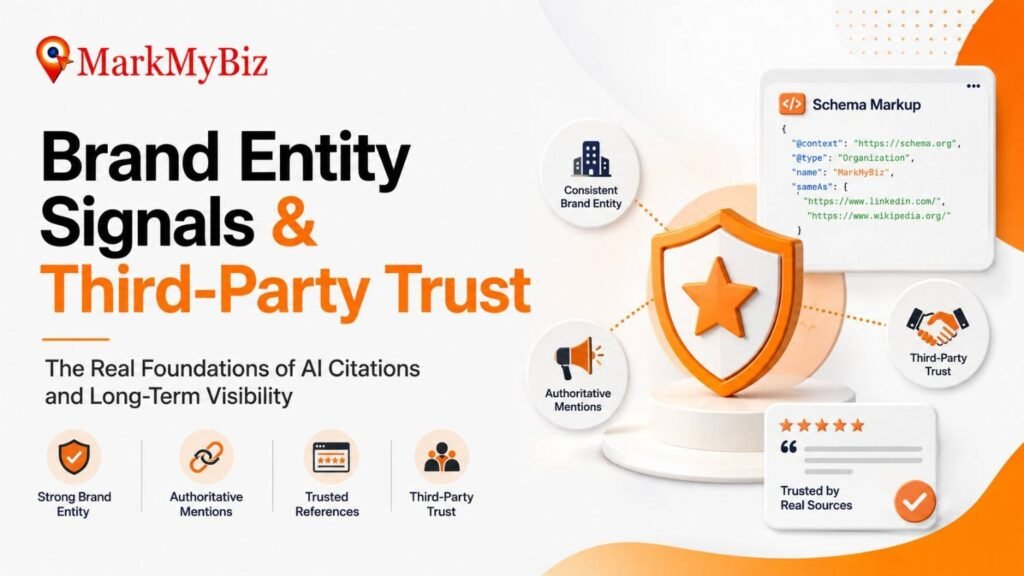
Ahrefs also looked at whether overall web visibility predicts AI mention share across the top 50 most-cited domains — a useful proxy for brand entity SEO. Google AI Overviews showed a moderate correlation (Spearman rho of 0.55) between web visibility and mention frequency. ChatGPT’s correlation was much weaker, around 0.20 — its ChatGPT citation sources lean on a narrower, more curated set rather than broad presence.
The takeaway: a clear, consistent brand entity — the same name, same details, same sameAs links pointing to your Wikipedia, Crunchbase, and LinkedIn profiles — matters more to Google’s systems than to ChatGPT’s, at least right now. Getting brand entity SEO right is unglamorous, but it’s one of the few AI search ranking factors you can fully control. Third-party trust signals like these are cheap to build and they compound.
Earned Media and Online Reputation
Third-party mentions — press coverage, industry roundups, genuine reviews you don’t control — function as external validation no schema block can fake. This is where earned media AI visibility actually gets built: AI systems, like human researchers, weight information more heavily when it’s corroborated elsewhere. Online reputation and AI citations move together for a reason, and earned coverage is far harder for a competitor to copy than a script tag.
Google AI Mode and ChatGPT: Platform-Specific Notes
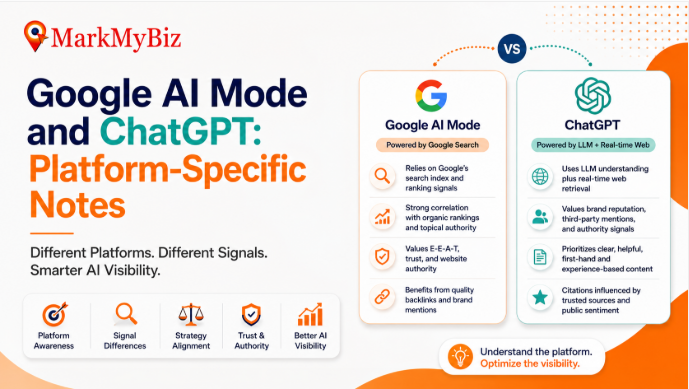
These systems don’t behave the same way, and treating “AI search optimization” as one checklist is a mistake.
When people talk about Google AI Mode optimization, they’re usually describing standard technical SEO with a new label. That’s not far off. Google AI Mode leans on the existing index and ranking signals, which is why organic ranking strength correlates more strongly with its citations than with ChatGPT’s.
When people talk about ChatGPT search optimization, they usually mean tactics borrowed from Google SEO — a mismatch. ChatGPT’s citation patterns correlate more weakly with organic rank or web visibility, relying instead on a smaller set of trusted, frequently-referenced ChatGPT citation sources and partnerships. Ranking #3 on Google buys you less here. Being the source other credible sites already point to buys you more than any amount of tweaking ever will.
An AI Search Optimization Checklist That Actually Works
Here’s the AI search optimization checklist we’d actually put in front of a client — a budget guide, not a box to tick:
- Rank well organically first — it’s still the strongest single predictor of AI citation likelihood.
- Implement schema correctly and completely, but treat structured data AI citations claims as technical hygiene, not a growth lever.
- Prioritize attribute-rich schema (Product, Review with real specs) over generic types (Article, Organization) if you have to choose where to spend dev time.
- Build a clean, consistent brand entity across Wikipedia, Crunchbase, LinkedIn, and industry directories, with matching
sameAsreferences. - Pursue earned media and genuine third-party trust signals — they’re harder to fake and they compound.
- Write content that demonstrates real, specific, first-hand experience instead of generic explainer copy.
- Audit which platform actually matters for your business — Google AI Mode optimization and ChatGPT search optimization pull on different levers, and stop treating generative engine optimization (GEO), answer engine optimization (AEO), and traditional SEO as one undifferentiated checklist.
Final Verdict: Is Schema Markup Worth It in 2026?
Yes — for the reasons it’s always been worth it. Implement it correctly and it helps search engines and AI crawlers parse your site without ambiguity, supports rich results where they still exist, and strengthens entity recognition over time. But don’t expect schema markup AI citations gains to show up on their own — the best controlled data available says they won’t.
That’s not the sexy answer. It’s the accurate one, and it’s what a good AI SEO consultant should tell you before you sign a retainer, not after. When you’re weighing AI citations vs organic rankings for next quarter’s roadmap, put the bulk of the budget behind rankings, content, and reputation.
Get an AI Visibility Audit from MarkMybiz
If you’ve already got schema implemented and you’re still not showing up in AI Overviews, ChatGPT, or Gemini — or your Google AI Mode citations have stalled — the fix probably isn’t more markup. It’s usually ranking strength, entity clarity, or a trust-signal gap.
MarkMybiz runs AI visibility audits that separate what’s actually holding your brand back from what just looks like a problem on a checklist. If you want a straight read on where your budget should go, that’s worth a conversation before next quarter’s SEO spend, not after it.