Quick Answer
Yes, indirectly. Your Google Business Profile shapes how Google understands your business — name, category, location, services and reviews — and that understanding feeds the local results shown inside AI Overviews and AI Mode. For ChatGPT, Gemini and Perplexity, GBP is one contributor to the public information those tools draw on, not a direct ranking input. A strong profile alone won’t earn an AI recommendation; it has to be backed by a consistent website, reviews and citations across the web.
Introduction: Why Businesses Are Asking Whether GBP Affects AI Recommendations
Not long ago, a new customer told a client of ours, an independent HVAC company, that “ChatGPT said to call you.” The owner was pleased, then slightly unsettled. Nobody on his team had done anything to earn that. He had a solid Google Business Profile, a decent website and a few hundred reviews, and somehow that added up to an AI recommendation. His question to us was simple: can we make that happen on purpose?
We hear versions of that question weekly now. For years, local business owners learned that a complete Google Business Profile (GBP) was the ticket to the Map Pack. Today their customers are asking Google’s AI Overviews, AI Mode, Gemini, ChatGPT and Perplexity for recommendations, and owners want to know whether the profile they worked on still matters.
It does. But the relationship between Google Business Profile and AI search is indirect, and anyone promising more than that is guessing. This article separates what Google has actually confirmed from what experienced SEOs reasonably infer, then lays out what a small business can do about it.
Does Google Business Profile Affect AI Search?
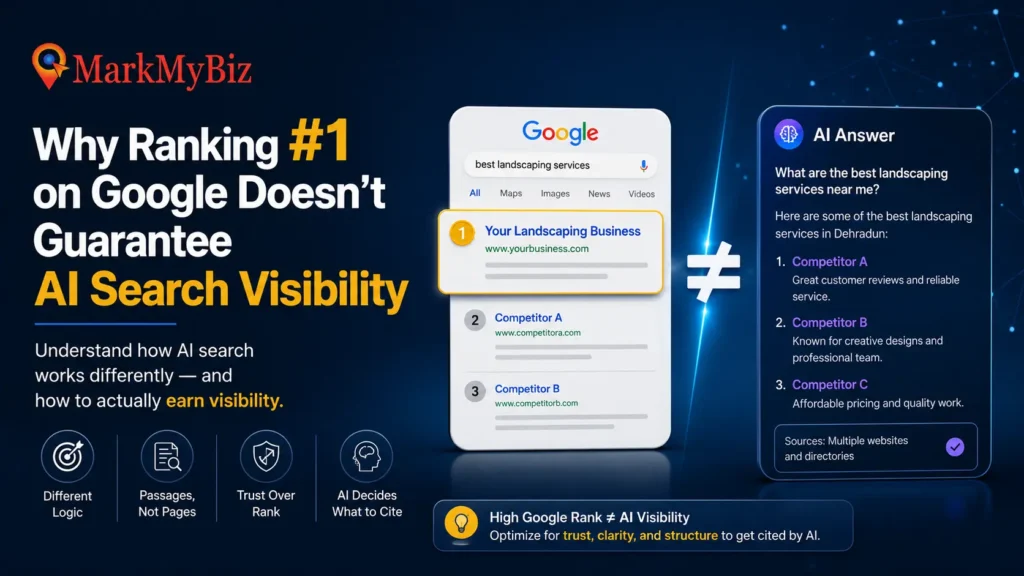
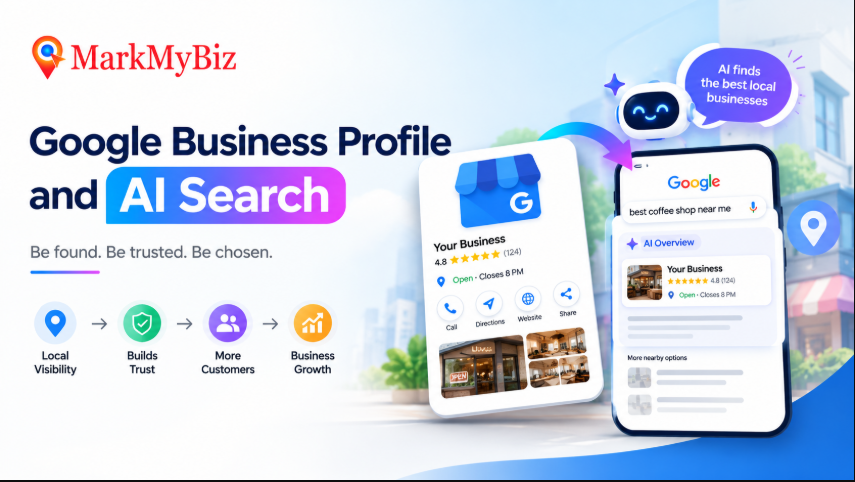
The direct answer: Yes, indirectly. Your Google Business Profile shapes how Google understands your business, including its name, category, location, services and reviews. That understanding drives Google’s local results, and those local results appear inside AI Overviews and AI Mode when someone asks a local question. For ChatGPT, Gemini and Perplexity, GBP is one contributor to the public information those tools draw on. It is not a direct ranking input for any of them.
What Google has confirmed
Two pieces of official documentation matter here. First, Google’s guidance on AI features in Search states that AI Overviews and AI Mode are built on the same core Search systems, and that there are no special requirements for content to appear in them beyond ordinary SEO best practices (Google Search Central, AI features and your website). Second, Google Business Profile Help explains that local results are ranked on relevance, distance and prominence, and that complete, accurate information helps Google match your business to relevant searches (How to improve your local ranking on Google).
What is interpretation
When a local query triggers an AI Overview, Google frequently shows a handful of businesses with Maps data alongside the summary. Because Google says those features run on its core systems, it is reasonable to infer that the same profile signals driving Map Pack visibility influence which businesses show up there. Google has not published a separate GBP-for-AI ranking factor list, and we would be cautious of anyone who claims otherwise.
ChatGPT, Perplexity and Gemini frequently cite Google Maps listings, review platforms, directories and business websites in their local answers. Your GBP feeds into that footprint. None of those platforms has explained how, or whether, it weighs the profile directly.
How Google Business Profile AI Search Visibility Works
The simplest way we explain this to clients is a chain:
GBP → Accurate Business Information → Local Relevance → Business Signals → Local Search Visibility → Broader Web Signals → AI Discoverability
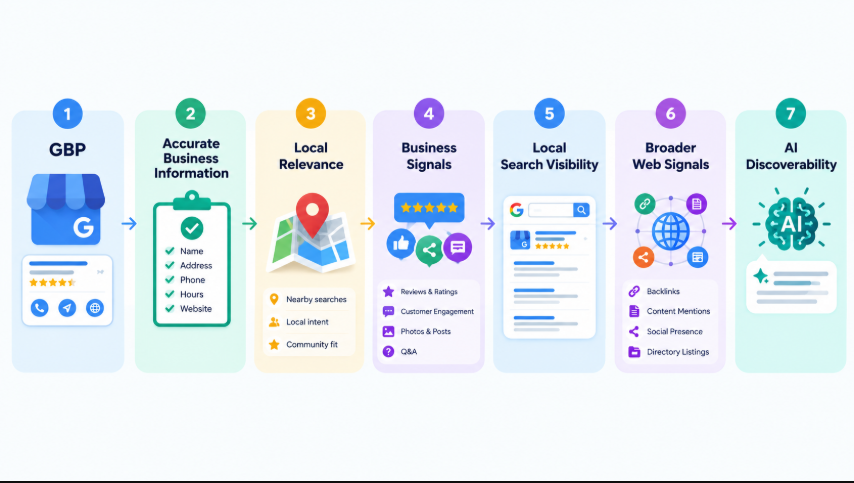
Your profile is where you state who you are, where you are, what you do and when you are open. Accurate information lets Google trust that statement. Relevance is Google matching your categories and services to real searches nearby. Business signals such as reviews, photos and engagement contribute to prominence. Local search visibility is the visible payoff: Map Pack placement, Maps rankings, the knowledge panel. Broader web signals from your website, citations and third-party reviews confirm the same facts. AI discoverability is what happens when an AI system, whichever one, finds a consistent, well-supported business it can describe with confidence.
GBP sits at the start of that chain. It is foundational, and it is also several steps removed from the AI answer itself. Both of those things are true at once.
What Are Google Business Profile Signals?
Google Business Profile signals are the details and activity on your profile that help Google judge relevance, distance and prominence. In our experience the ones that carry the most practical weight are:
- Primary and secondary categories. The primary category is the single strongest declaration of what your business is.
- Name, address and phone number (NAP). The anchor for your business identity across the entire web.
- Hours, including holiday hours. Google specifically lists accurate hours as a way to improve local ranking.
- Services and products. Specific entries (“emergency furnace repair”) match far more intent than generic ones (“HVAC”).
- Reviews and your responses. Google confirms review count and quality factor into local ranking, and that responding shows you value customers.
- Photos, description, attributes and Q&A. Context that clarifies who you serve and how.
- The website link. The bridge between your profile and the site that AI tools actually read.
Google confirms that complete, accurate profiles are easier to match to the right searches. How much any individual signal influences an AI-generated answer is not documented, and we treat claims to the contrary as speculation
Can GBP Influence AI Recommendations for Local Businesses?
Yes, with a strength that varies by platform.
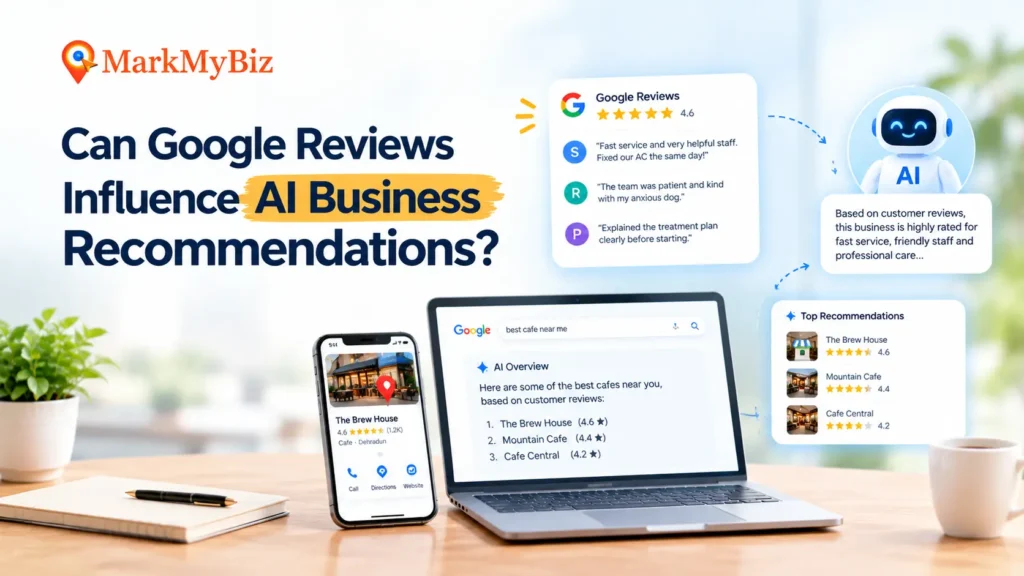
Google AI Overviews and AI Mode. This is the clearest link. A query like “pediatric dentist near me open Saturday” often returns an AI summary plus Maps-style listings. Because Google states these features share its core systems, your local optimization work carries straight over.
Gemini. Gemini can ground answers in Google Search and Maps. It is reasonable to expect accurate GBP data helps Gemini describe you correctly. Google has not published Gemini recommendation criteria for local businesses.
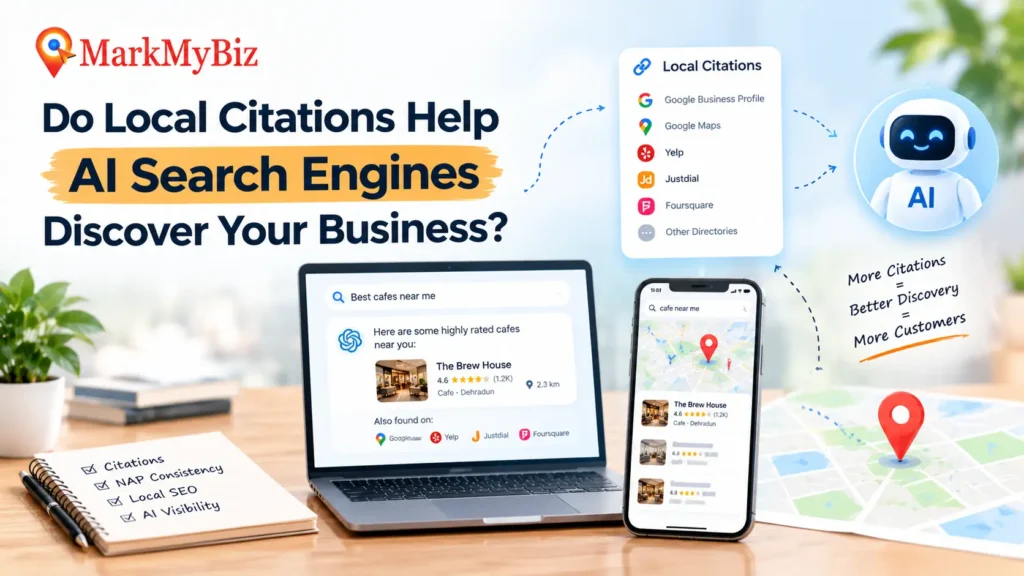
ChatGPT. ChatGPT’s search feature retrieves public web pages and cites them (OpenAI Help Center, ChatGPT search). It does not read your profile dashboard. What it finds is the trail your GBP helps create: your website, directories, review sites and articles that describe you. When those sources disagree, ChatGPT has less to be confident about.
Perplexity. Perplexity is built around citations. For local recommendations it tends to pull from review platforms, “best of” roundups and business websites, sometimes including Maps listings.
Here is an illustrative scenario we use in workshops. A Denver physical therapy clinic sets its primary category to “Physical therapy clinic,” adds dry needling and post-surgical rehab as named services, builds a website page for each, and reaches sixty detailed reviews. When someone asks an AI assistant for a Denver clinic offering dry needling after knee surgery, that clinic now has a specific, consistent, well-reviewed footprint to be found in. Nothing about that guarantees a recommendation. It makes the clinic findable and describable, which is the part you actually control.
Why Local SEO Still Matters for AI Search
AI search tools do not know anything about your business on their own. They summarize what already exists. Local SEO is the work that creates what exists: location pages, service content, citations, reviews, local press coverage and structured data.
A business with a single thin “Contact Us” page and a half-finished profile gives an AI system almost nothing to summarize. A business whose site plainly explains what it does, where, for whom and why customers trust it hands every AI platform raw material. That is why we still treat local SEO as the engine and AI visibility as an outcome, rather than the other way around.
NAP Consistency and AI Search Visibility
NAP consistency means your business name, address and phone number are identical everywhere they appear. Here is a pattern we see constantly during audits:
| Source | Name | Address | Phone |
|---|---|---|---|
| GBP | Bright Smile Dental | 120 Main St, Suite 4 | (555) 201-1000 |
| Website footer | Bright Smile Dental Care | 120 Main Street | (555) 201-1000 |
| Yelp | Bright Smile Dentistry | 120 Main St #4 | (555) 201-1001 |
Formatting differences like “St” versus “Street” are generally harmless. Three different names and two phone numbers are not. From an AI standpoint the interpretation is intuitive: systems assembling answers from many sources favor entities they can identify without ambiguity. Conflicting facts introduce doubt, and doubt is a poor foundation for a recommendation.
The fix is unglamorous. Audit your top fifteen to twenty citations, standardize everything to match your GBP, and update your website’s contact details and LocalBusiness structured data to say the same thing.
GBP Is Only One Part of Your AI Visibility Strategy
If you perfected your profile and did nothing else, you would still be missing most of the picture. A complete local business AI visibility strategy also depends on:
- A website with real authority and clarity, written for the questions people actually ask.
- LocalBusiness structured data so Google can read your details unambiguously (Google Search Central, Local Business structured data).
- Reviews on platforms beyond Google.
- Consistent citations across directories.
- Brand and entity mentions in local news, partner sites and roundups.
- Content that AI can quote: plain definitions, FAQs and process explanations.
How to Optimize Your Google Business Profile for Better AI Search Visibility
The checklist we run for every new client
- Verify the profile and merge or remove duplicates.
- Use your real-world business name with no added keywords, as required by Google’s guidelines for representing your business.
- Choose the most specific primary category available, then add relevant secondary categories.
- Fill in every service and product with specific, descriptive names.
- Write a description that says who you serve, where and what sets you apart.
- Set accurate hours, including holidays, and keep them current.
- Add genuine photos on a regular schedule.
- Ask satisfied customers for reviews and respond to every one, good or bad.
- Answer common questions in Q&A before customers ask them.
- Link to the most relevant page on your site, not automatically the homepage.
- Confirm your website’s NAP and schema match the profile exactly.
Mistakes we see most often
Keyword-stuffed business names (a guidelines violation that can trigger suspension), broad categories chosen when specific ones exist, empty service fields because “customers already know,” ignored reviews, stale hours after a schedule change, and a profile linked to a website showing a different phone number.
Does Google Maps SEO Matter for AI Search?
Yes. Google Maps SEO and Google Business Profile optimization are largely the same work, and Maps data is what appears inside AI Overviews for local queries and can ground Gemini’s answers. Perplexity and ChatGPT cite Maps listings in some responses too. Strong Maps visibility does not guarantee AI citations. Weak Maps visibility almost certainly limits them.
How to Improve Your Overall AI Search Visibility
- Audit the basics. Profile completeness, NAP consistency, site speed, mobile usability.
- Build a page for every meaningful service. Each should answer what, where, for whom, how pricing works and what to expect.
- Write FAQ content in the language customers use. “Do you offer same-day repairs in Round Rock?” outperforms “Our Services.”
- Implement LocalBusiness and FAQ structured data.
- Earn reviews on multiple platforms and keep responding.
- Pursue local mentions. Chamber listings, local news, sponsorships, supplier partner pages.
- Monitor AI answers. Ask ChatGPT, Gemini and Perplexity what your customers ask, note who gets recommended and why, and close the gaps.
Google’s own advice for succeeding in AI experiences echoes this: focus on unique, helpful content and a good page experience rather than chasing AI-specific tricks (Google Search Central Blog, Top ways to ensure your content performs well in Google’s AI experiences).
When Should You Consider Professional GBP or AI SEO Help?
Most owners can work through the checklist above on their own. Outside help becomes worth it when a profile has been suspended or duplicates keep reappearing, when multiple locations make consistency hard to hold, when competitors keep showing up in AI answers and you cannot see why, or when there is simply no time to produce the content and citations AI tools rely on.
Google Business Profile optimization services and Google Maps SEO services cover the profile and Maps layer. Local SEO services extend that to your website and citations. AI SEO services or AI search optimization services address the wider layer: content structure, entity consistency and monitoring across AI platforms. Ongoing Google Business Profile management suits businesses whose hours, services or locations change often.
At MarkMyBiz, we work across all of these layers for small and mid-sized businesses, and we treat GBP as the foundation rather than the whole strategy. If you want a second opinion on your profile and your AI footprint, that is a sensible place to begin.
Frequently Asked Questions
Does Google Business Profile affect AI search?
Indirectly, yes. GBP shapes how Google understands your business, which influences the local results shown in AI Overviews and AI Mode. For ChatGPT, Gemini and Perplexity it contributes to the public information they draw on but is not a direct ranking input.
Can a Google Business Profile get my business recommended by ChatGPT?
Not on its own. ChatGPT cites publicly available web pages. A strong GBP supports a consistent online footprint, but your website, reviews and citations do most of the work.
Is GBP a confirmed ranking factor for Google AI Overviews?
No. Google has not published GBP as a distinct AI Overviews ranking factor. Google says AI features use its core Search systems and need no special optimization, so standard local SEO applies.
Why does NAP consistency matter for AI visibility?
AI tools assemble answers from many sources. When your name, address and phone match everywhere, systems can identify your business confidently. Conflicting details create ambiguity.
Does Google Maps SEO help with AI recommendations?
Indirectly, yes. Maps data appears in AI Overviews for local queries and can ground Gemini’s answers. Strong Maps visibility does not guarantee recommendations, but weak visibility limits them.
What matters more for AI visibility: my GBP or my website?
Both, for different reasons. GBP anchors your local identity within Google. Your website is what most AI tools actually read and cite. Neglect either and you leave a gap.
Key Takeaways
- GBP affects AI search indirectly, not as a direct ranking input for any AI platform.
- Google confirms AI Overviews and AI Mode run on core Search systems, so standard local SEO carries over — no separate “AI ranking factors” exist.
- ChatGPT and Perplexity don’t read your GBP dashboard; they cite public web pages, so your website, reviews and directory listings do most of the work for those platforms.
- NAP consistency (name, address, phone) across GBP, your website and directories reduces ambiguity that undermines AI confidence in recommending you.
- GBP is the foundation, not the whole strategy — a complete AI visibility approach also needs an authoritative website, LocalBusiness structured data, multi-platform reviews and consistent citations.
- The fastest way to know where you stand is to ask ChatGPT, Gemini and Perplexity what your own customers would ask, and see who gets recommended.
Conclusion
Your Google Business Profile does affect AI search, as a foundation rather than a lever. It tells Google who you are, supports local visibility and feeds the wider footprint AI systems rely on. What it cannot do is guarantee a ChatGPT recommendation, a Gemini mention, a Perplexity citation or a place in an AI Overview.
The practical path has not changed much: complete the profile honestly, keep your NAP consistent, build a website that answers real questions, earn reviews and mentions, and check what AI tools are actually saying about you. Businesses that do that steadily tend to show up where it counts, in Maps today and increasingly in AI answers.