Quick Answer: Website architecture is how your pages are organised, linked, and presented to both visitors and search engines. A clean website architecture for SEO helps Google crawl and index your pages faster, spreads ranking authority through smart internal linking, and lets real visitors reach what they need in a few clicks. Get the structure right, and your rankings and your user experience improve together — not at each other’s expense.
Ask five business owners what SEO means, and you’ll probably get five different answers — keywords, backlinks, maybe “that blog thing.” Almost nobody mentions the actual skeleton holding their website together, and that’s usually the first thing quietly working against them.
At MarkMyBiz, we’ve spent years building, auditing, and rescuing websites for clinics, coaching institutes, real estate firms, and e-commerce brands across Dehradun and beyond. One pattern shows up on repeat: sites with a clean, logical website architecture for SEO consistently outrank competitors with flashier design but a messier structure underneath. It isn’t a technical detail you patch in later — it’s the foundation everything else, from content to conversions, gets built on.
What Is Website Architecture, In Plain English?
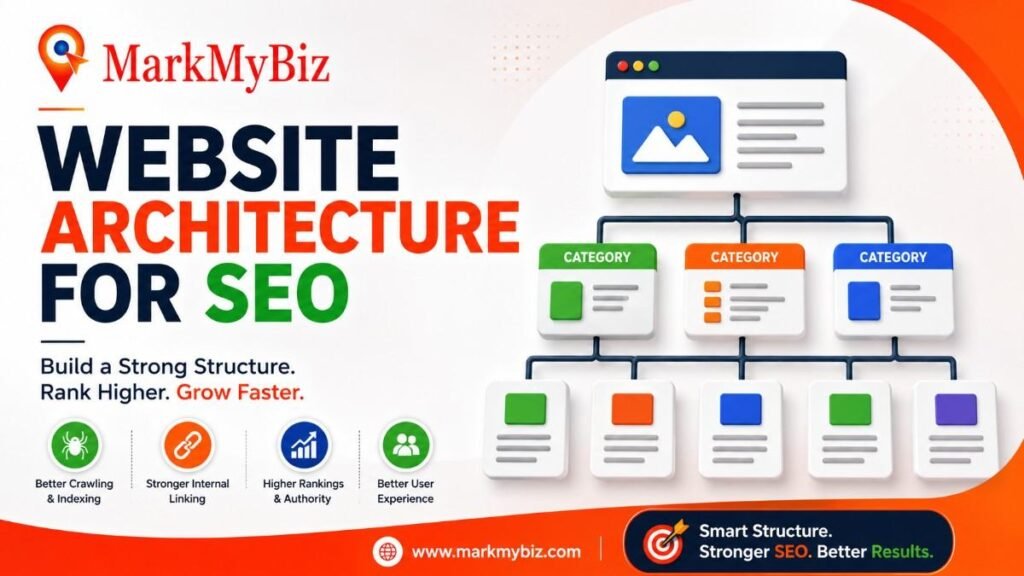
Strip away the jargon, and website architecture is simply the floor plan of your site: which pages sit under which category, how many clicks it takes a visitor — or a Google bot — to reach a specific page, and how your internal links tie it all together into one coherent whole.
A well-planned SEO-friendly website architecture does two jobs at once. It tells search engine crawlers which pages matter most and how they relate to one another, and it guides a real, slightly impatient human toward whatever they came looking for — a service page, a product, a contact form — without making them hunt for it. When both goals are handled by the same structure, you end up with a site that ranks well and actually converts the traffic it earns.
Why Website Architecture for SEO Really Moves the Needle
Search engines rarely judge a single page on its own — they look at how that page fits inside your entire site. Three things carry real ranking weight here.
Crawl Budget and Indexing
Every website gets a limited “crawl budget” — the number of pages a search bot bothers to crawl in one visit. A flat, well-linked SEO website structure helps bots find and index your important pages quickly. A deep, tangled one wastes that budget on low-value pages while your money pages sit unindexed for weeks.
Internal Linking and Authority Flow
Internal links pass authority from page to page. When your homepage links to key category pages, which in turn link to relevant service pages, that authority flows through the site logically. Orphan pages — ones nothing links to — almost never rank, no matter how good the writing is.
Speed, Core Web Vitals, and Clean Code
Architecture isn’t only about hierarchy. It’s also about how cleanly your templates, scripts, and assets are put together behind the scenes. A bloated, disorganised build slows load times, and page experience is a ranking factor Google has been fairly upfront about.
The Core Ingredients of an SEO-Friendly Website Structure
Every high-performing site we’ve shipped through our website development services shares a handful of non-negotiable traits:
- A shallow hierarchy — aim for every page to be reachable within three clicks of the homepage.
- Clean, descriptive URLs — a URL like /services/website-development tells users and crawlers exactly what to expect.
- Strategic internal linking — related pages linking to each other in context, not just buried in a menu.
- Breadcrumbs and clear navigation — these reinforce hierarchy for humans and bots alike.
- An updated XML sitemap and robots.txt — explicit instructions on what to crawl and what to skip.
- A genuinely responsive website structure — because none of the above matters if half your visitors are on mobile and the layout falls apart.
Get these right, and you’ve built the backbone of a real SEO-friendly website architecture — not just a good-looking homepage.
Responsive Website Structure: Why Mobile-First Stopped Being Optional
Most of your traffic is arriving on a phone, whether your analytics dashboard has caught up to that reality or not. Google primarily uses mobile-first indexing now, which means the mobile version of your site is essentially the version being evaluated for ranking. A responsive website structure isn’t a bonus feature bolted onto a desktop design anymore — it’s the baseline. If your navigation collapses awkwardly, text needs pinch-zooming, or buttons sit half a millimetre apart on a small screen, that’s not just annoying — it’s actively working against your website structure for SEO, one frustrated tap at a time.
A User-Friendly Website Structure Keeps People From Leaving
Here’s the thing about structural problems — they rarely stay confined to SEO. A confusing menu that hurts crawlability also sends real visitors hunting for information, which shows up as a higher bounce rate. Pages buried four or five clicks deep get fewer visits even when they’re exactly what someone needed. Broken internal links and inconsistent templates quietly erode trust, especially on mobile, where every extra tap is a chance for someone to give up and try a competitor instead.
Over time, these friction points land in your analytics as lower dwell time and fewer conversions — and eventually, lower rankings too, since search engines do factor in how people behave once they land on a page. A genuinely user-friendly website structure isn’t a “nice to have” layered on top of SEO. It’s the same work, viewed from a different angle.
How We Build SEO-Friendly Website Development Into Every Project
If you’re building a new site or fixing an old one, this is roughly the sequence we follow on every SEO-friendly website development project at MarkMyBiz:
- Map keywords to pages first. Before any wireframe gets drawn, we work out what your audience is actually searching for and give each real search intent its own page.
- Sketch the sitemap before the design. A simple hierarchy diagram stops the common mistake of designing pretty pages first and forcing structure around them later.
- Lock in clean URL and navigation logic early. Folder depth, naming conventions, and menu structure get decided before development starts, not patched in afterward.
- Bake in technical SEO from day one. XML sitemaps, robots.txt, canonical tags, and schema markup are part of the build, not an afterthought at launch.
- Audit and refine continuously. As new pages get added, we check for orphaned content, broken links, and crawl errors before they become a real problem.
This is the same process behind every project handled through our website development services, whether it’s WordPress, a custom CMS, or a static build.
Business Website Development Isn’t One-Size-Fits-All
Generic structure advice only goes so far — the right setup depends on the kind of business website development you actually need.
Service-based businesses tend to do better with one dedicated page per core service, rather than burying everything under a single crowded “Services” page, since each page can then target its own keyword cluster.
E-commerce stores need an airtight category-to-subcategory-to-product hierarchy, with filters handled carefully so they don’t spin off thousands of thin, duplicate URLs nobody asked for.
Local businesses need consistent contact details and location-specific pages that match how people in their city actually search — something that pairs naturally with the digital marketing services and local SEO work we handle alongside structure and design.
Whatever the industry, the underlying rule for custom website development stays the same: organise content around what customers are searching for, not around your internal org chart. It’s an approach we’ve carried across real estate, healthcare, travel, and education projects — you can see some of that work in our portfolio.
Structure Mistakes That Quietly Cost You Rankings
A few patterns we see constantly when auditing sites that aren’t performing:
- Every service crammed onto one page instead of getting its own URL and its own shot at ranking.
- Orphan pages that nothing on the site links to, so neither Google nor visitors ever stumble across them.
- Deep nesting, where a genuinely important page sits five or six clicks from the homepage.
- Missing breadcrumbs, leaving visitors — and crawlers — with no sense of where they are on the site.
- A structure copied from a template, with no thought given to how a real customer actually browses.
None of these are difficult to fix once you know to look for them, which is really the whole point of getting your SEO website structure right from the start rather than patching it later.
Why Businesses Choose MarkMyBiz for Custom Website Development
A developer who only thinks in colours and fonts will hand you a site that looks sharp on launch day and quietly struggles six months later. What actually helps is a team that treats structure, SEO, and design as one connected system from the very first conversation.
That’s the approach we’ve built our website development services around at MarkMyBiz. We’re a Dehradun-based team with hands-on experience across healthcare, education, real estate, travel, and e-commerce, and we plan site structure alongside broader digital marketing service and graphic design work, so every page you launch is built to rank, not fixed after the fact. Learn more about our team on the about page, or browse real client sites in our portfolio.
The Short Version
Website architecture is the part of SEO that’s easy to ignore, because it never shows up on a content calendar or a keyword spreadsheet. But it decides whether everything else you do even gets a fair chance to work. A clean, SEO-friendly website architecture makes your site easier for search engines to crawl, easier for real visitors to use, and easier for your business to grow. Nail the business website development foundation, and your rankings and your user experience stop competing with each other and start moving in the same direction.
Not sure if your current site’s structure is helping or hurting you? Talk to our team for a straight, no-jargon look at your website architecture for SEO — or call us directly at +91-7457810379.
Frequently Asked Questions
What’s the difference between website architecture and website design?
Website design is about how things look — colours, layout, typography. Website architecture is what’s underneath: how pages are organised, categorised, and linked. A beautifully designed site with poor architecture will still struggle to rank.
How many clicks should it take to reach any page on my site?
Three is the general rule of thumb. Pages buried deeper than that get crawled less often, receive less internal link authority, and get fewer clicks from real visitors too.
Does website structure really affect mobile rankings?
Yes. Since Google mainly uses mobile-first indexing, your navigation, structure, and internal linking need to work just as well on a phone as on a desktop. A responsive website structure is part of the ranking equation now, not an extra.
Can I fix my site’s structure without a full redesign?
Usually, yes. Reworking internal links, cleaning up URLs, updating the sitemap, and reorganising navigation can often be done without touching the visual design at all.
How soon will I see SEO results after restructuring my website?
Crawling and indexing improvements typically show up within a few weeks. Ranking movement tends to become visible over two to three months, once search engines re-evaluate the updated structure.
Do small businesses really need to worry about website architecture for SEO?
Yes — arguably more than larger sites. Smaller sites have fewer pages to work with, so every page needs to be found, indexed, and linked well, leaving less room for structural waste.