A client called us in a bit of a panic a few months back. She’d typed her own business name plus “near me” into ChatGPT, half-joking, expecting to see herself pop up. Instead, ChatGPT named two competitors and a directory listing she’d never heard of. Her business? Nowhere.
That moment is becoming pretty common. People aren’t just Googling anymore — they’re asking. “Who’s a solid family dentist in Austin that takes new patients?” “Which accounting firm actually understands crypto taxes?” The AI answers with a short, confident list. No ten blue links to scroll through. Just names.
So the question we get asked constantly, in some form or another, is this: how do I get my business to be one of the names the AI says out loud?
We’re going to give you the real answer, not the marketing-page version. And the real answer starts with something a lot of “AI SEO” companies won’t tell you upfront.
There Is No Submit Button
You cannot pay ChatGPT to mention your business. You cannot fill out a form on Gemini’s site and request a citation. If a vendor is selling you “guaranteed AI placement,” ask them to explain the mechanism — because neither OpenAI nor Google has ever offered one, and nothing in either company’s public documentation describes anything resembling paid AI recommendations.
What you can do is build a business that’s genuinely easy for these systems to find, understand, verify, and ultimately trust. It’s a lot like earning a recommendation from a well-networked friend who only vouches for businesses they’d actually stake their reputation on. You don’t buy that kind of trust. You build it, in public, over time.
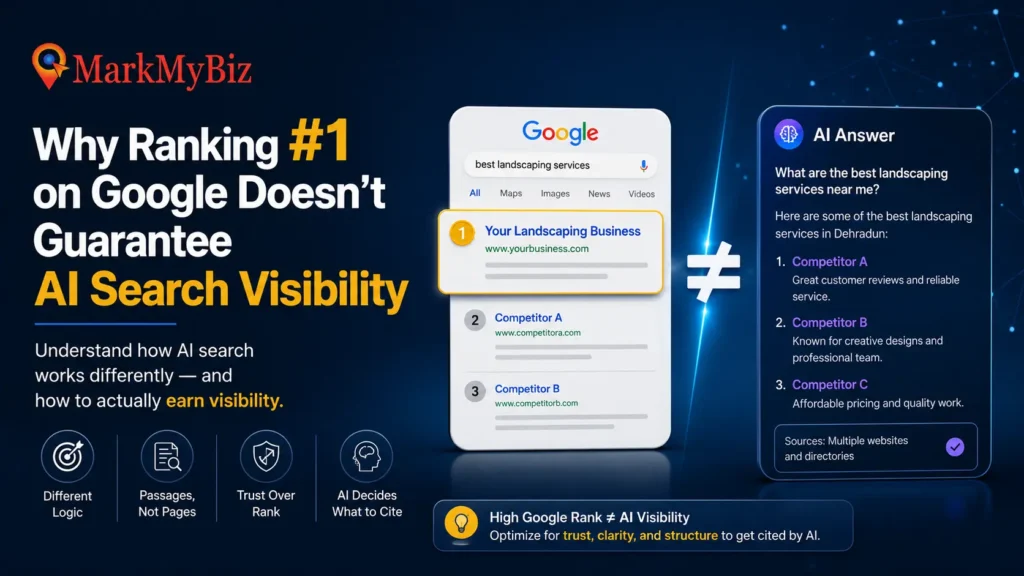
Here’s the part that surprises people: most of what builds that trust is just good, disciplined SEO and reputation work — the kind that’s been effective for over a decade. What’s changed isn’t the underlying principles. It’s who’s reading the evidence, and how that evidence gets folded into one synthesized paragraph instead of a ranked list of ten links.
We manage AI visibility work for dozens of local and regional service businesses at MarkMyBiz, and this article reflects patterns we’ve watched play out repeatedly across those accounts — not a theory we read somewhere and repackaged.
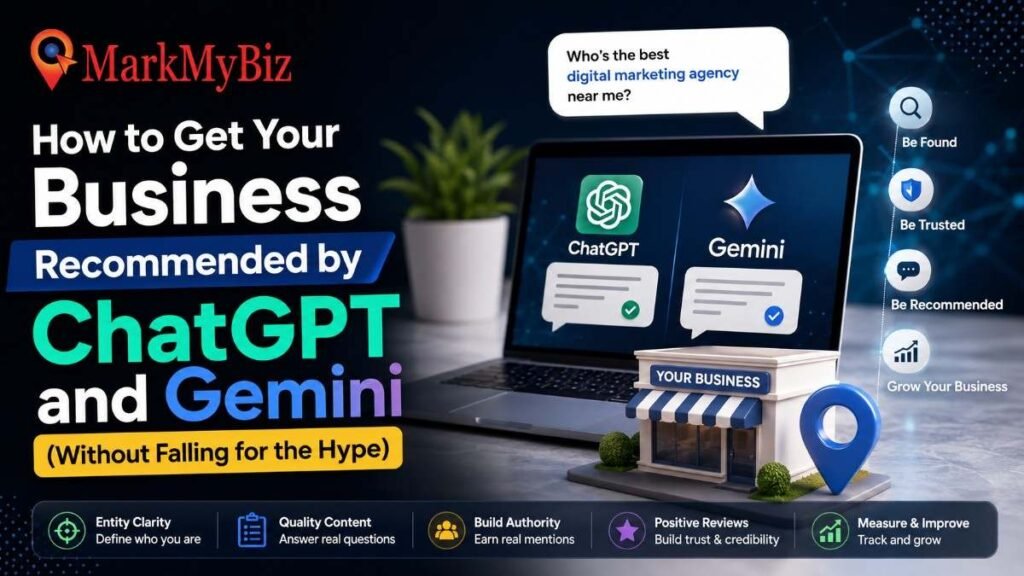
The Short Version, If You’re Skimming
- Define your business as one clean, unambiguous entity — same name, same services, same location, everywhere.
- Write pages that answer real customer questions instead of describing your company in marketing fluff.
- Demonstrate actual depth in your field, not just a homepage and a “Contact Us” button.
- Keep your NAP (name, address, phone) and service details identical across your site, directories, and profiles.
- Build a genuine base of specific, honestly-earned reviews.
- Earn coverage from outside sources — press, directories, associations, partners.
- Nail the local SEO fundamentals if you serve a defined geographic area.
- Confirm your key pages are actually reachable by crawlers — not blocked, not buried behind JavaScript.
- Use structured data accurately so machines don’t have to guess.
- Track whether AI tools are actually mentioning you, and adjust based on what you learn instead of what you assume.
None of this guarantees a mention next Tuesday. What it does is remove every easy excuse an AI system would have to skip over you — missing details, contradictory information, zero independent proof, or a site it literally cannot read. Let’s go through each piece properly.
How ChatGPT and Gemini Actually Decide Who to Mention
Neither OpenAI nor Google has published their exact ranking formula, and anyone claiming to have reverse-engineered it is selling you confidence they don’t actually have. What we do have is enough publicly documented behavior to work with intelligently.
When someone asks a commercial question — “best physiotherapist near me,” “who handles ecommerce SEO in Dubai” — the model usually can’t answer from what it memorized during training alone. It needs current information, so it runs something close to a live retrieval process: pull relevant pages, weigh how credible and current they look, then generate an answer grounded in what it found.
A few concepts show up again and again in how these systems are publicly described:
Entity resolution. The system needs to recognize “ABC Digital” as a specific, real business with a location and a category — closer to how a knowledge graph works than simple keyword matching.
Corroboration. A claim your website makes about itself is weak on its own. The same claim showing up independently on a review platform, a directory, or in a news article carries a lot more weight. Outside evidence functions almost like a second signature on a contract.
Freshness. For anything time-sensitive — pricing, hours, “who’s the best right now” — systems doing live retrieval lean toward content that’s current.
Location and intent matching. For local searches, geographic relevance still functions much like it always has in traditional local search.
Basic accessibility. If a crawler can’t reach or render your page, it can’t be part of any answer. That’s not a penalty — it’s a locked door.
There’s no public evidence of a single unified “AI visibility score” at either company, and the exact weighting between these factors almost certainly isn’t fixed — both companies iterate on these systems constantly. The safest working model: these systems are trying to give a confident answer, and they reach for sources that make that confidence easy to justify. A clearly described, independently verified, easily accessible business simply makes that job easier for them.
Getting Found by ChatGPT Specifically
OpenAI documents three distinct crawlers, and mixing them up is one of the more expensive mistakes a business can make in its robots.txt file.
- GPTBot collects content for training OpenAI’s underlying models. Blocking it doesn’t remove your site from ChatGPT’s live search answers — it only opts you out of potentially informing future model training.
- OAI-SearchBot is the one tied specifically to ChatGPT’s search features, and it’s the crawler that matters most for whether your pages can actually surface inside a live answer. OpenAI’s documentation on this has been revised more than once, and the current guidance allows you to permit OAI-SearchBot for search visibility while still blocking GPTBot for training — they’re independently controllable.
- ChatGPT-User fires when an actual live user action — inside ChatGPT, a Custom GPT, or a GPT Action — triggers a real-time fetch of a specific page. It’s reactive, not a proactive crawl.
Here’s the practical risk: if your robots.txt blocks every AI-sounding user-agent indiscriminately (a shortcut we still see surprisingly often), you may be removing yourself from ChatGPT’s search answers entirely, not just declining to be used in training. Since OpenAI updates this list periodically, check your robots.txt against their current published crawler documentation directly, rather than trusting any blog post — ours included.
Beyond crawler access, a few things consistently matter for ChatGPT visibility:
Basic discoverability first. Pages need to be indexable, load reasonably fast, and not hide critical content behind JavaScript a crawler won’t execute.
Specificity beats polish. “We offer digital marketing services” tells a retrieval system almost nothing useful. “We manage Google Ads and local SEO for HVAC companies in Texas” gives it something concrete to match against an actual query.
Depth over decoration. A handful of thin service pages don’t demonstrate expertise. Enough substantive content to show you genuinely understand the space does.
Independent corroboration. This is where we see the biggest gap in client sites, consistently. Businesses spend heavily on their own copy and almost nothing on getting genuinely mentioned elsewhere.
Factual consistency. Same business name, same service descriptions, same location details, worded identically everywhere they appear. It sounds trivial. It removes a surprising amount of friction for a machine trying to resolve who you actually are.
One honest caveat: what ChatGPT surfaces for a given query can shift with exact phrasing, the user’s location, timing, and which sources happen to be freshly indexed at that moment. Two people asking nearly the same question minutes apart can get different results. That’s not a flaw in your strategy — it’s simply how these systems behave right now, and it’s exactly why one good mention doesn’t mean you’re reliably, permanently visible.
Getting Found by Gemini Specifically
Gemini deserves its own section because it is genuinely a different animal, built on different infrastructure — not ChatGPT wearing a different logo. Gemini’s visibility surfaces (Google’s AI Overviews, AI Mode, and the standalone Gemini app) lean heavily on Google’s existing Search index and ranking systems. Per Google Search Central’s own guidance, AI Overviews pull from the same index as regular organic search, and there’s no separate markup or schema required for citation eligibility there.
That means a lot of what already worked for traditional Google visibility still applies:
- General organic Search visibility, because AI Overviews and AI Mode sit directly on top of the same index.
- A fully completed, accurate Google Business Profile — especially critical for local queries.
- Local SEO fundamentals: citations, reviews, service-area pages.
- The same entity clarity every AI system cares about, regardless of vendor.
- Structured data used correctly and honestly, not stuffed with unearned claims.
- Content quality that Google’s own guidance frames as “non-commodity” — real first-hand expertise or a genuine point of view, not a generic overview a model could have written itself.
One structural detail worth knowing: in mid-2026, Google rolled out a Search Console-level control — first in the UK, under regulatory pressure — letting site owners exclude their content from AI Overviews, AI Mode, and AI Overviews inside Discover specifically, while remaining fully indexed in regular search results. That control doesn’t extend to the standalone Gemini app, which runs on its own separate retrieval pipeline. Most businesses have no reason to opt out of anything here, but it’s worth understanding that “regular Google visibility” and “AI Overview visibility” are now more separable than they used to be, and that the Gemini app is a genuinely distinct surface from Gemini-inside-Search.
Making Your Business Legible to a Machine
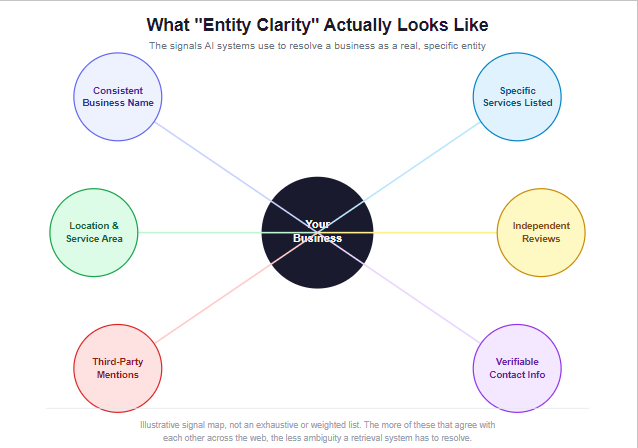
Strip away the jargon, and “entity optimization” just means one simple thing: can a machine reading your site figure out, without guessing, exactly who you are?
That means being explicit about:
- Your business name, used identically everywhere — not “ABC Digital” here and “ABC Digital Marketing LLC” there
- Your services and service categories, spelled out plainly
- The specific locations or areas you actually serve
- Who’s behind the business, and how long you’ve operated
- What genuinely differentiates you from competitors
- Any industry certifications or association memberships you hold
- Anywhere credible third parties have already mentioned you
Here’s what the difference looks like in practice:
Weak: “ABC Digital is a leading digital marketing company.”
Strong: “ABC Digital is a Dubai-based digital marketing agency specializing in local SEO, Google Business Profile optimization, and ecommerce SEO for small and mid-sized businesses.”
The first sentence is a claim with nothing behind it. “Leading” is subjective and unverifiable, and it shows up on roughly every competitor’s homepage in some form. No retrieval system can corroborate it, and no customer query maps cleanly onto it. The second sentence hands the system four usable facts: location, business type, three specific specialties, and a target customer segment. Ask about ecommerce SEO in Dubai, and version two gives an AI a real reason to consider you a match. Version one gives it nothing to work with at all.
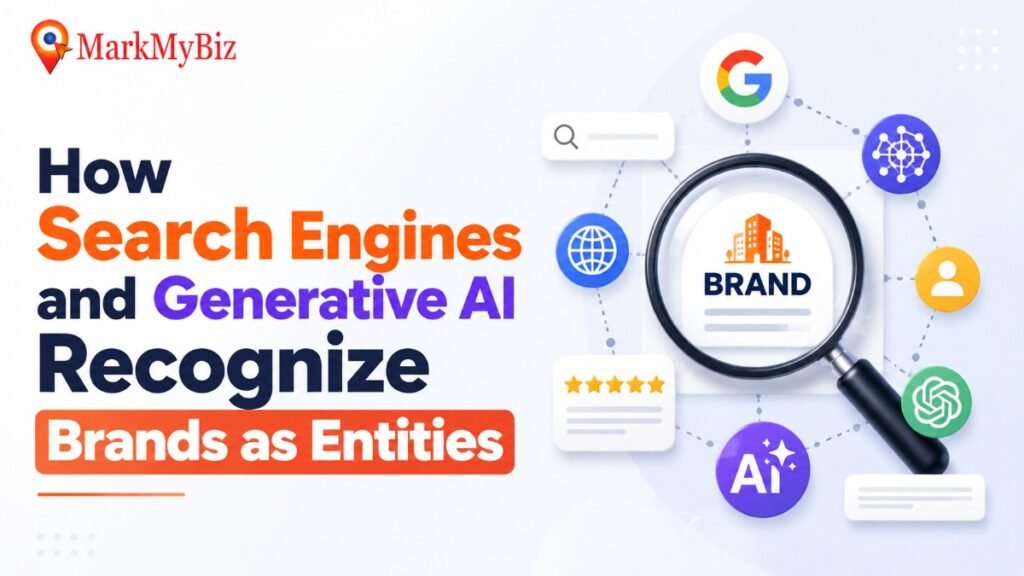
(Below: a simplified map of the entity signals AI systems tend to look for when trying to resolve exactly who your business is.)
Writing Content AI Can Actually Trust
The instinct to “write content for AI” is understandable but slightly off-target. The real goal is content that’s genuinely useful to a human reader and structured clearly enough that a machine reading it isn’t left guessing. Those two goals turn out to be nearly the same exercise.
In practice, that means:
- Service pages that describe exactly what you do, for whom, and how — not copy that could apply to any competitor with the logo swapped out.
- Location pages with genuinely distinct content, if you serve more than one area, rather than the same template with the city name changed.
- Honest comparison content that fairly weighs your options, including ones you don’t sell. That kind of candor is one of the clearest trust signals there is, for humans and machines alike.
- Detailed FAQs answering what customers actually ask, in the language they actually use.
- Real pricing information where it’s reasonable to share it. Vague pricing is one of the most common reasons an AI-generated answer hedges on a business or skips it entirely.
- Original data or research, even something modest — it’s far more citable than a generic claim.
- Case studies with real specifics, not vague success stories.
- Clear author and company information, so a reader can tell who wrote this and why they’d know.
- Sensible internal linking that helps both readers and crawlers understand how your content connects.
None of this is about tricking a system into citing you. It’s about removing the ambiguity that makes any retrieval system hesitant to rely on you as a source in the first place.
Building Real Topical Authority
One well-written page rarely establishes authority on its own. What tends to build it is a cluster of related content that, together, proves you genuinely understand the space — not just that you can produce one good landing page and call it a day.
Say a business wanted topical depth around “AI search optimization.” Supporting content might reasonably include pieces on what GEO actually is, how it differs from traditional SEO, how AI citations work mechanically, how ChatGPT and Gemini differ in their approach, how to measure AI search visibility over time, and what entity SEO looks like in plain language.
Individually, each piece answers one narrow question. Together, they signal something a single article never can: sustained, structured expertise. And that’s closer to how both human readers and retrieval systems actually judge whether a source deserves trust.
Why What Others Say About You Outweighs What You Say About Yourself
Here’s a distinction a lot of “AI SEO” advice glosses right over: there’s a real difference between what you claim about yourself and what other people independently say about you.
“We are the best SEO agency in the region.”
versus
A respected industry publication lists the agency among notable regional SEO providers.
The first is marketing copy — unverifiable, and it shows up on nearly every competitor’s homepage in some form. There’s no particular reason a retrieval system, or a skeptical human reader for that matter, should weigh it heavily. The second is independent evidence. It exists outside your control, and that’s precisely what makes it useful as corroboration.
Worth genuinely pursuing:
- Industry and trade publications
- Local news coverage
- Reputable, relevant directories — not link-farm directories nobody actually reads
- Professional associations and certifications
- Interviews and podcast appearances
- Expert quotes inside journalist-written articles
- Digital PR built around something actually newsworthy
- Relevant review platforms
- Organic mentions in forums or niche communities where your business comes up naturally
One thing worth saying bluntly: don’t fake any of this. Paid placements dressed up as editorial coverage, purchased “best of” list spots with no real editorial standard, fabricated interviews — this kind of thing tends to unravel the moment anyone looks closely, and there’s little reason to think manipulated mentions age well as these platforms get better at spotting exactly this pattern.
Do Reviews Actually Help?
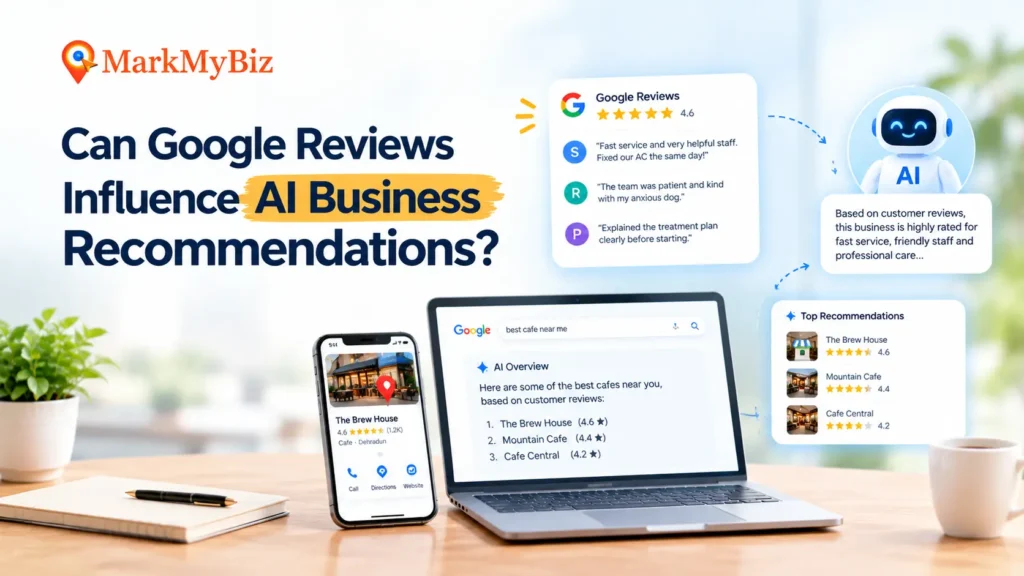
Reviews are one of the more genuinely useful signals a small or local business has, mostly because they’re a rare source of independent, first-person language about your business that you don’t fully control. That’s valuable. It’s also easy to accidentally undermine.
What tends to matter: enough volume to represent more than a handful of anecdotes, quality and specificity in what customers actually write, recency, and whether the language customers use naturally lines up with what your own site claims about you. How you respond to reviews — good and bad — says something too.
Here’s a mistake worth naming directly. Some businesses try to engineer this by coaching customers:
Don’t: “Please mention ‘best SEO company in Dubai’ in your review.”
That’s keyword-stuffing wearing a customer-feedback costume, and it reads as obviously artificial — to a human skimming reviews, and increasingly to systems trained to spot templated, coached language.
Do: Simply ask the customer to honestly describe what they liked about working with you, in their own words.
Genuine, specific language gives real context that a generic five-star rating never can. But it’s worth being upfront about the limits here too — there’s no public evidence that reviews function as a direct, guaranteed AI ranking factor. They’re one piece of a larger trust picture, not a lever you pull on their own and expect results overnight.
Local SEO Isn’t Dead — AI Just Builds on Top of It
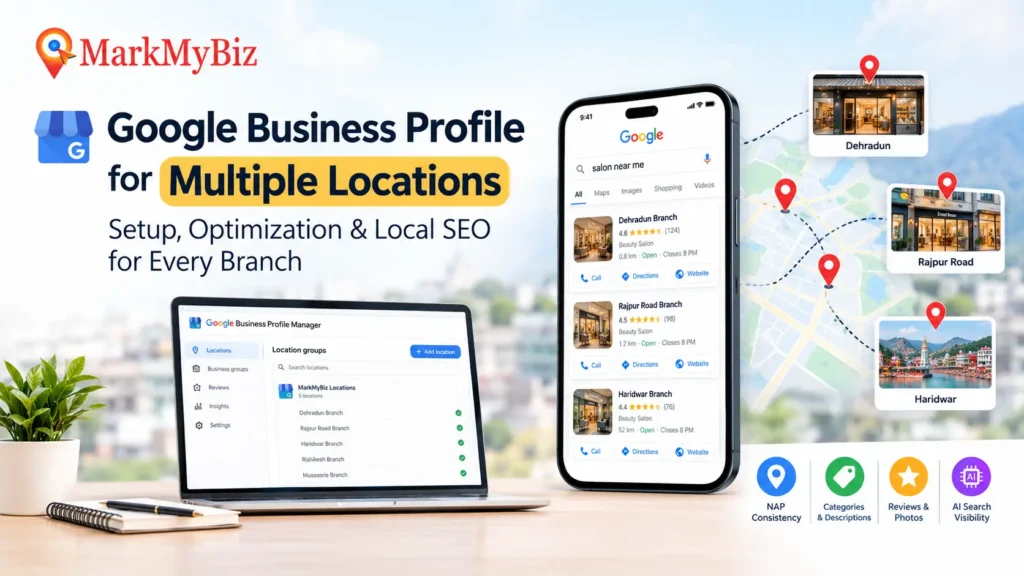
If you serve a specific geography, local SEO doesn’t get replaced by GEO. In most cases, GEO simply layers on top of it. A complete, accurate Google Business Profile, consistent NAP data across citations, genuine local reviews, and location-specific content all remain foundational — because Gemini in particular is drawing from the exact same index and local-ranking infrastructure that’s powered Google Maps and local search results for years.
Technical Accessibility and Structured Data
Even the best content in the world does nothing if a crawler can’t reach it. Before anything else, confirm:
- Your robots.txt isn’t accidentally blocking OAI-SearchBot or Google’s crawlers
- Critical content doesn’t rely entirely on client-side JavaScript a bot won’t render
- Your sitemap is current and submitted
- Canonical tags aren’t creating conflicting signals about which page is authoritative
- Page load times are reasonable, not just for users but for crawl efficiency
On structured data: schema markup (Organization, LocalBusiness, Service, FAQPage, and similar Schema.org types) can meaningfully reduce ambiguity in how a machine interprets facts about your business. It is not, on its own, a guaranteed AI ranking or citation mechanism — but accurate structured data removes one more excuse for a system to misread or skip you.
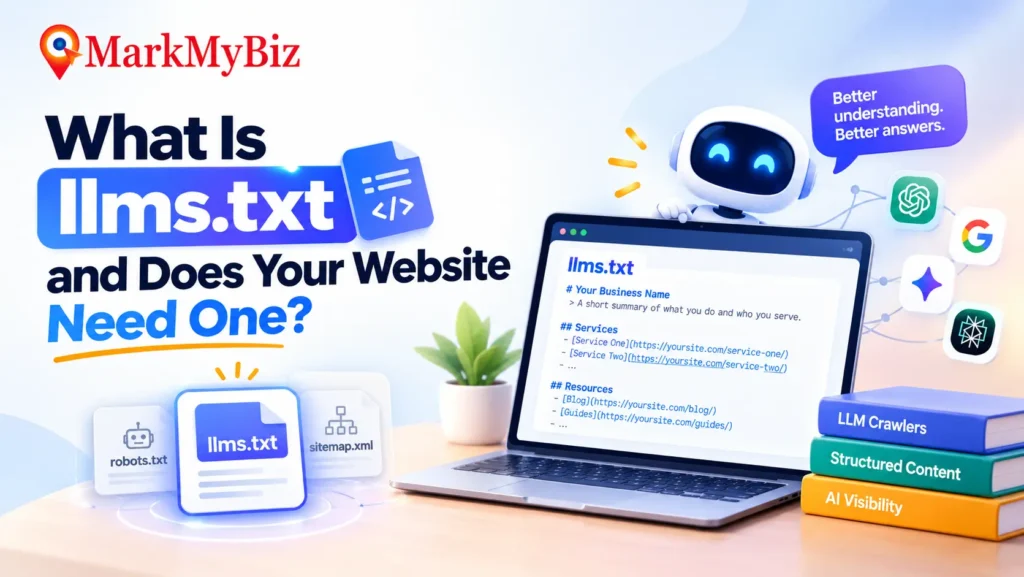
A quick, honest note on llms.txt: the current evidence doesn’t support the idea that it improves AI visibility. Independent monitoring shows major AI crawlers request llms.txt files only rarely compared to ordinary page crawling, and Google has stated directly that it doesn’t support the format. It’s a low-cost, low-risk addition some businesses add as groundwork for future AI-agent navigation, but it shouldn’t be mistaken for a substitute for content quality, entity clarity, or genuinely earned authority.
How to Actually Measure This (Instead of Guessing)
| What to Track | What It Tells You | How to Measure It |
|---|---|---|
| Mentions | Whether AI tools reference your business at all | Manual prompt testing on ChatGPT and Gemini |
| Citations | Whether your site is used as a cited source | Manual testing + noting linked sources in answers |
| Referral traffic | Whether users click through from an AI answer to your site | Web analytics, filtered by AI-platform referral sources |
| Leads | Whether prospects were actually influenced by an AI interaction | CRM tagging and source attribution |
| Revenue | Whether it ties back to real business outcomes | CRM and attribution modeling |
A word of caution on limitations: mentions and citations are the easiest to observe and the hardest to act on directly — they’re an outcome, not a lever you pull. Referral traffic is more actionable but currently a small slice of most sites’ overall traffic, since a lot of AI answers satisfy the user without any click at all. Revenue attribution is the most meaningful number and the hardest to isolate cleanly, since AI-influenced customers often touch several channels before they ever convert.
Two Ways to Picture the Journey
Traditional search journey: Query → Search Results → Website → Click → Conversion
AI search journey: Question → AI Retrieval → Synthesized Answer → Citation or Recommendation → Visit or Conversion
The core difference is where comparison-shopping happens. In traditional search, it happens after the click, across a dozen open tabs. In AI search, a meaningful chunk of that comparison now happens before the click, buried inside the synthesized answer itself. That’s exactly why being one of the sources these systems trust enough to draw from matters as much as it now does.
A Realistic 30-Day Plan
Week 1 — Foundation. Audit how your business entity information appears across your website, Google Business Profile, and major directories, and flag anything inconsistent. Check technical indexability — robots.txt, sitemap, canonical tags, rendering. Fully complete your Google Business Profile. Fix inconsistent NAP data wherever you find it. Identify which services deserve their own dedicated page instead of a shared paragraph on a general services page.
Week 2 — Content. Rewrite thin or vague service pages using specific, concrete language — the weak-versus-strong example above is a solid template. Build question-led content addressing what customers actually ask. Improve author and “about” information with real, verifiable credentials. Build out genuinely useful FAQs, not filler. Tighten internal linking between related pages.
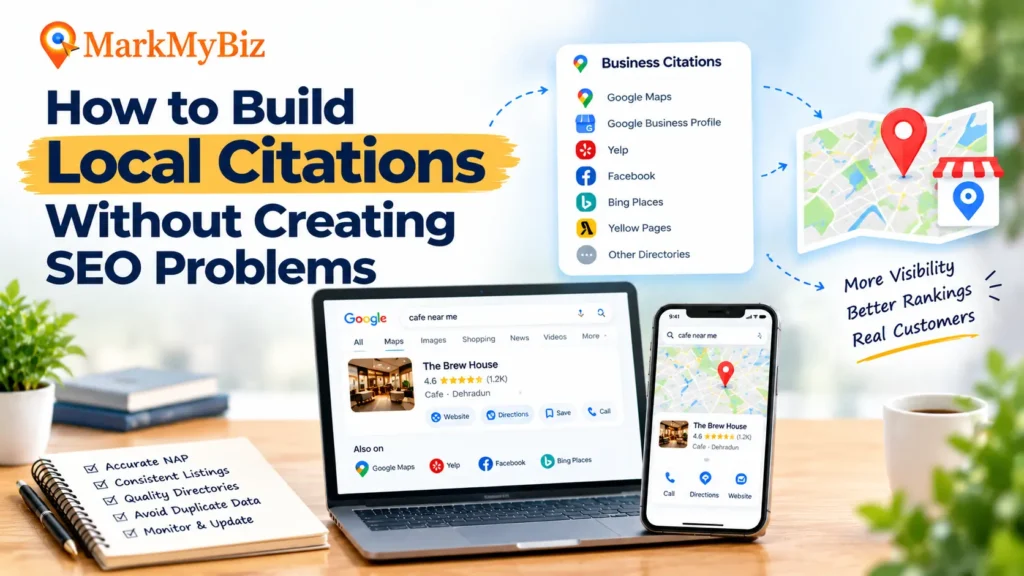
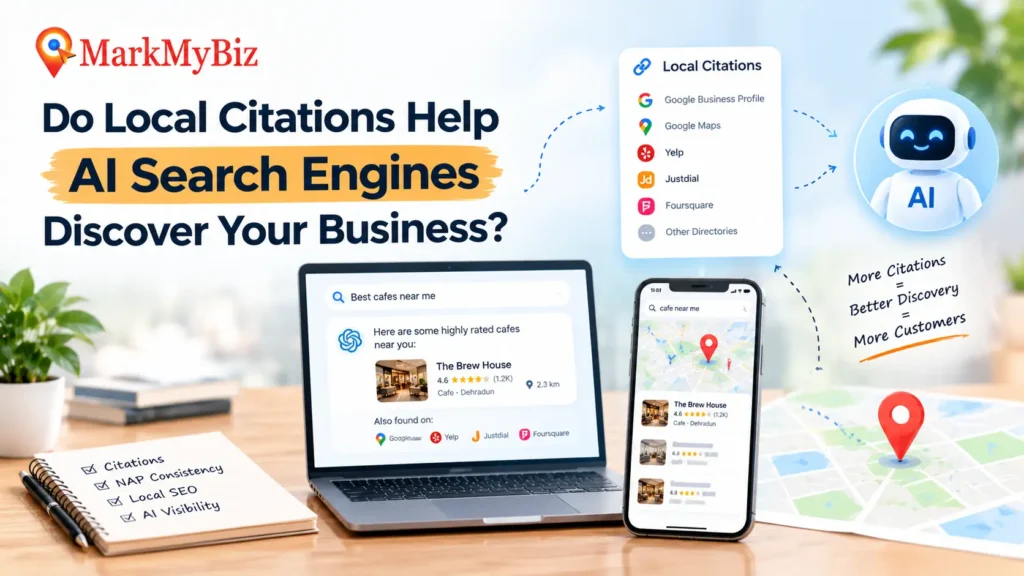
Week 3 — Authority. Set up an ethical, non-templated process for requesting customer reviews. Identify five to ten relevant publications, directories, or associations worth pursuing for a genuine mention. Clean up and build legitimate local citations. Chase one or two realistic PR opportunities tied to something genuinely newsworthy about your business. Look for expert-quote, interview, or podcast opportunities in your niche.
Week 4 — Measurement. Build a list of 20 to 50 realistic customer prompts. Run them across ChatGPT and Gemini and record a baseline — mentioned or not, cited or not, which competitors appeared, which sources were used. Set up basic tracking for AI-platform referral traffic in your analytics. Note which competitors and sources currently dominate the answers you tested. Calendar a repeat test 30 days out, because you’re tracking a trend, not judging a single snapshot.
Frequently Asked Questions
Can I submit my business directly to ChatGPT?
No. There’s no submission form, paid listing, or direct way to request a ChatGPT recommendation. ChatGPT’s answers are generated in response to a query, often grounded in live retrieval from the web, so the practical path is making your business easy to discover, understand, and verify online — not petitioning the platform.
How does ChatGPT choose which businesses to recommend?
OpenAI hasn’t published the exact ranking mechanics, and no outside party can honestly claim to know them precisely. Based on publicly available documentation, ChatGPT’s search features rely on retrieval from indexed web content, generally favoring sources that are accessible to its crawlers, relevant to the query, and corroborated by independent evidence. Results can vary by phrasing, timing, and location, so a single good (or bad) result isn’t a reliable signal of consistent visibility.
How do I appear in Gemini’s answers?
Gemini-powered surfaces like AI Overviews and AI Mode draw on Google’s existing Search index, so strong traditional SEO — indexability, quality content, structured data, local SEO, and reviews — remains foundational. Google has stated there’s no separate markup required for AI Overview eligibility; standard helpful-content and structured-data guidance applies. The standalone Gemini app runs on its own retrieval pipeline, so results there can genuinely differ from what shows up inside Google Search.
Does regular SEO help with ChatGPT visibility?
Yes, indirectly and substantially. Good SEO fundamentals — crawlable pages, clear entity information, quality content, and earned authority — make it easier for any retrieval-based AI system, ChatGPT included, to find and trust your business. It’s not a guarantee, but weak SEO makes AI visibility considerably less likely.
Do reviews affect AI recommendations?
Reviews provide independent, human-written evidence about your business that AI systems can draw on as part of a broader trust picture. There’s no public evidence that reviews function as a direct, standalone AI ranking factor, but volume, specificity, recency, and consistency with your other business information plausibly all contribute to how trustworthy and well-documented your business appears.
Does schema markup actually help with AI search?
Structured data can make factual details about your business — address, services, hours, reviews — easier for machines to interpret accurately, reducing ambiguity or misreads. It’s not a guaranteed AI ranking or citation mechanism, and Google has been explicit that AI Overviews don’t require any special schema beyond its existing structured-data guidance.
Does adding llms.txt improve AI visibility?
Current evidence doesn’t support that claim. Independent monitoring shows major AI crawlers request llms.txt files only rarely compared to ordinary page crawling, and Google has stated directly that it doesn’t support the format. It’s low-cost groundwork some businesses add for future AI-agent navigation, but it’s not a substitute for content quality, entity clarity, or genuinely earned authority.
How do I measure my AI search visibility over time?
Build a consistent set of realistic customer prompts, test them across ChatGPT and Gemini on a recurring schedule (monthly is reasonable), and record whether your business is mentioned, cited, or recommended — along with which competitors and sources appear instead. Pair that with analytics tracking for AI-platform referral traffic and CRM attribution for leads and revenue, so you’re measuring actual business impact instead of collecting isolated screenshots.
The Honest Takeaway
There’s no secret trick hiding at the bottom of this article, and if that feels anticlimactic, it’s the truthful ending. Getting recommended by ChatGPT or Gemini isn’t a separate discipline you bolt onto your existing marketing. It’s what tends to happen naturally when a business becomes easy to discover, easy to understand, easy to verify, worth citing, and — eventually — worth recommending.
Work on those, roughly in that order, and measure honestly as you go. That’s the whole strategy.
About This Guide
This article was written and is maintained by the MarkMyBiz editorial team, based on hands-on AI visibility work we run for local and regional service businesses. We update it as OpenAI and Google publish new documentation, since crawler behavior and platform mechanics genuinely do shift over time — check the date at the top before treating any specific technical detail as current.
Sources & Further Reading
- OpenAI — crawler documentation covering GPTBot, OAI-SearchBot, and ChatGPT-User
- Google Search Central — guidance on AI Overviews and structured data
- Google Search Console — documentation on AI Overviews/AI Mode content controls
- Schema.org — vocabulary reference for Organization, LocalBusiness, Service, and FAQPage types
- Google Business Profile — official help documentation
- Independent AI-crawler traffic monitoring (SE Ranking, Limy.ai, aeo.press) on llms.txt adoption and bot behavior
This guide reflects publicly available documentation and our own agency experience as of the last-updated date above. Neither OpenAI nor Google has published a complete, guaranteed ranking formula for AI-generated recommendations, and no legitimate source can promise you a specific outcome.