A client came to us last quarter with a strange problem: their Google rankings hadn’t moved in months, but their branded search volume was climbing, and new leads kept mentioning “I read about you somewhere” without a clear referral source. That’s the AI search measurement gap in miniature. A website can rank well in Google and barely show up in AI-generated answers. It can be cited by ChatGPT dozens of times a month and show almost no traffic to prove it. It can be mentioned by name with no link back to the site at all.
None of that shows up in a rankings report. If you’re still judging a website’s health by position tracking and organic sessions alone, you’re missing most of what’s actually happening. Performing well in AI search isn’t one number — it’s a chain of separate, measurable events, and each one tells you something different.
What Does Performing Well in AI Search Actually Mean?
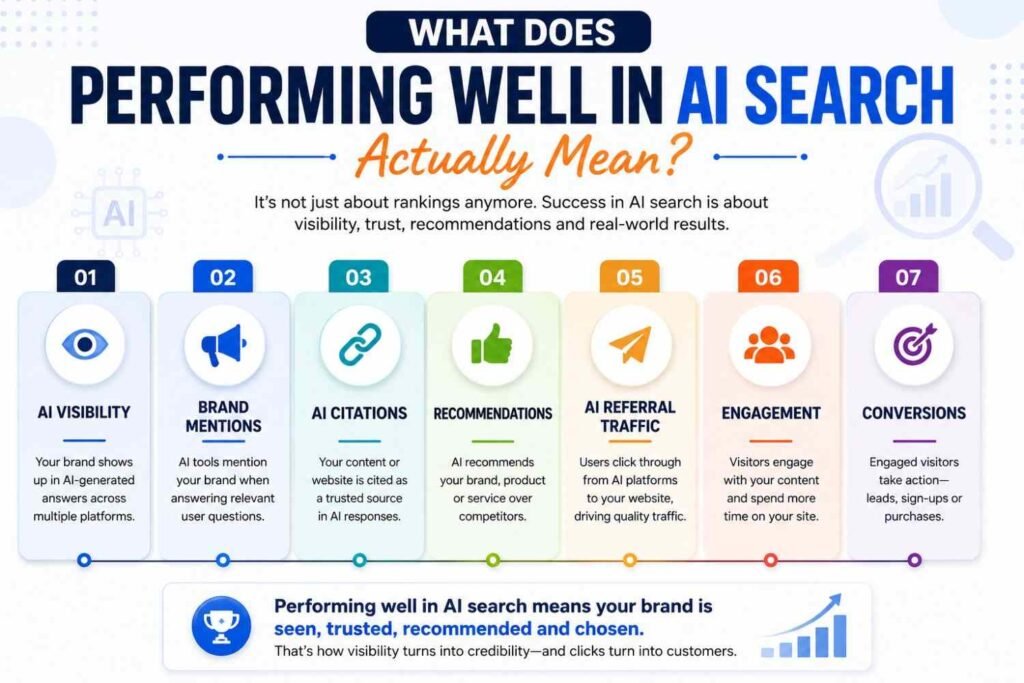
“Performing well” gets used loosely, so it’s worth being precise. There are at least four distinct things an AI platform can do with a brand, and they are not the same event:
- A mention is when an AI answer names your brand, with or without a link.
- A citation is when an AI answer includes a clickable source pointing to your actual page. Industry researchers at Data-Mania note that a citation carries a URL while a mention is only a name-check — the citation is the one that can drive a visit and signal to the model that your content is a trustworthy source.
- A recommendation is when the AI actively puts your brand forward as the answer to the user’s problem, not just as one name among several.
- A conversion is what happens after someone actually clicks through and takes an action on your site.
Being cited doesn’t guarantee a recommendation. And traffic from any of the above doesn’t guarantee revenue. Each stage has its own failure points — which is exactly why these need to be measured separately rather than trusting one metric to represent the whole picture.
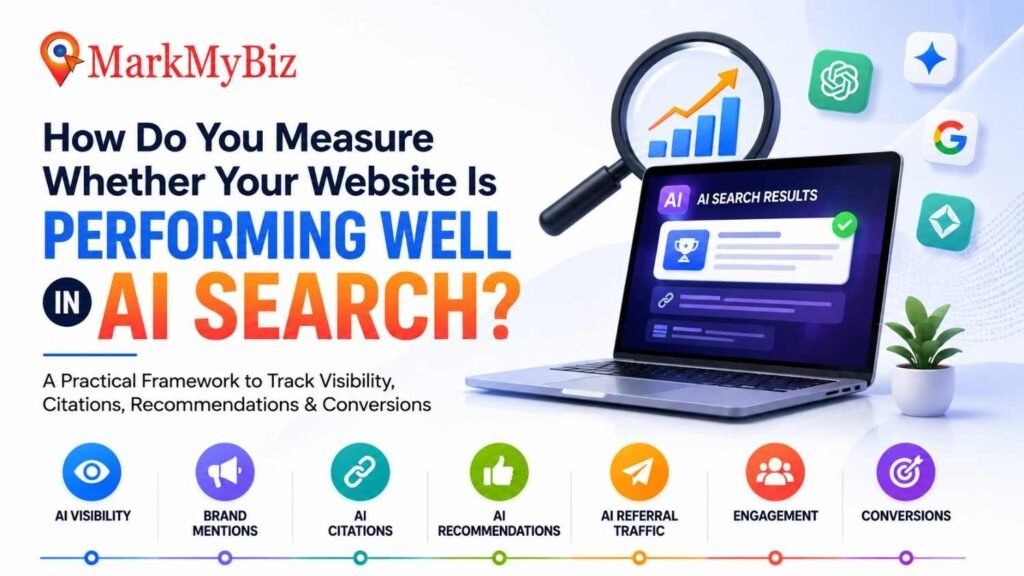
7 AI Search Performance Measures You Should Track
1. AI Search Visibility
Visibility sits at the top of the funnel: how often does your brand or website show up at all when someone asks a relevant question in ChatGPT, Gemini, Google’s AI Overviews, AI Mode, or Perplexity? This only becomes measurable once you commit to asking the same set of questions repeatedly — a single spot-check tells you almost nothing, since AI answers vary between sessions, models, and even time of day.
Consultancies tracking this at scale describe building a “prompt panel” — typically 30 to 50 real buyer questions run on a fixed monthly schedule across multiple platforms — then logging every brand that gets named. Some vendors describe a “Brand Visibility Score” (mentions divided by total relevant answers checked) as a rough North Star, though it’s worth treating that as an internal benchmark you calculate yourself rather than an official metric any AI platform publishes.
2. Brand Mentions
This is the most basic signal: does the AI platform say your brand’s name at all? Track mention frequency (how often, out of your prompt panel, your brand appears), which competitors show up alongside you, and the context of the mention — is it accurate, is it flattering, is it even about the right product line? A brand can be “mentioned” while being described incorrectly, which is arguably worse than not appearing at all.
3. AI Citations
Citations are a step up from mentions because they involve an actual link back to your content. Google’s AI Overviews and AI Mode pull cited pages using a technique Google calls “query fan-out” — running multiple related searches behind the scenes and surfacing a broader set of supporting links than a standard results page would show. Google has been explicit that appearing as a cited source in these features creates real opportunities for pages that wouldn’t otherwise be discovered through classic rankings.
Platform-level research also shows citation behavior varies a lot by model. Semrush’s 2026 AI Visibility Index found ChatGPT cites an average of around 15 sources per response, leaning heavily on community platforms like Reddit and reference sites like Wikipedia, while Gemini cites closer to 3 sources per response from a narrower pool. That gap matters practically: a brand can look strong in one AI environment and nearly invisible in another simply because of how each model sources its answers — a good reason to track citations platform by platform instead of as one blended number.
4. AI Recommendations
Mentions and recommendations are not the same thing, and this distinction is where a lot of AI-visibility reporting goes soft. Being named in a list of five options is a mention. Being the answer the AI puts forward first, or singles out as the best fit, is a recommendation.
To test this honestly, run realistic buyer-intent prompts — something like “what are the best website development agencies for small businesses” or “how do I choose an SEO agency” — and record not just whether your brand appears, but where it lands in the answer and how it’s framed. Resist the temptation to assume results here; the only credible way to know is to run the prompts yourself and log what actually comes back.
5. AI Referral Traffic
This is where measurement gets technically messy, and it’s worth understanding why. When someone clicks a link inside ChatGPT, Perplexity, or Gemini, the referrer header that tells your analytics platform “this visitor came from an AI tool” is frequently stripped by the app’s embedded browser or mobile client. GA4 then has nowhere to put that session except “Direct” — the same bucket as someone typing your URL from memory.
As of mid-2026, Google Analytics rolled out a native “AI Assistant” channel that automatically groups recognized AI chatbot traffic, but coverage is inconsistent: it reliably catches ChatGPT, Gemini, and a handful of others, while Perplexity traffic and some Claude traffic still land elsewhere depending on how the referral survives. The more durable fix most analytics teams use is a custom channel group in GA4 — a regex rule matching domains like chatgpt.com, perplexity.ai, claude.ai, and gemini.google.com, placed above the default Referral rule and applied retroactively so historical sessions get reclassified too. Even with that in place, treat the number you see as a floor, not a ceiling — some AI-referred visits will never carry attribution data at all.
On the Google Search side specifically, Search Console launched dedicated Generative AI performance reports in June 2026 that isolate impressions coming from AI Overviews, AI Mode, and AI features in Discover, broken down by page, country, device, and date. That’s useful for visibility trending, but click data for AI Overview appearances isn’t fully built out yet, and Search Console only ever reports on Google’s own AI surfaces — it has no visibility into ChatGPT, Perplexity, or any platform outside Google’s ecosystem. For those, GA4 is the only place to look.
6. Engagement and Conversion Quality
Traffic volume alone is a weak signal — what matters is what AI-referred visitors do once they land. Segment AI traffic using the channel group above and compare engaged sessions, time on page, and conversion events against other channels. Some third-party analytics research has reported that AI-referred sessions convert at meaningfully higher rates than average organic traffic, which lines up with the intuitive explanation: someone arriving after reading a detailed AI-generated answer has often already been pre-qualified by that explanation before they ever click through.
Track this at the level that matters for the business — enquiries, form fills, calls, quote requests — not just sessions. A spike in AI referral traffic that never turns into a lead is a data point worth investigating, not celebrating.
7. AI Search Share of Voice
Once mention, citation, and recommendation data exist from a prompt panel, share of voice can be calculated: your citations as a percentage of all citations that show up for your prompt category. This shows whether a brand is gaining or losing ground relative to named competitors over time, using the exact same question set for everyone so the comparison stays fair.
It helps to be clear with stakeholders that this is a measurement framework built in-house, not a metric any AI platform hands over directly. Its value comes from consistency — the same prompts, the same platforms, the same recording method every month — not from any single reading.
AI Search Measurement Scorecard
Use this table as a monthly reporting template. Each row maps to one of the seven measures above.
| Metric | What to Measure | Why It Matters | Frequency |
|---|---|---|---|
| AI Visibility | Brand appearances across a fixed prompt panel | Baseline discoverability in AI answers | Monthly |
| Brand Mentions | Mention frequency and accuracy of context | Brand presence and message accuracy | Monthly |
| AI Citations | Cited URLs/pages, by platform | Source visibility and content authority | Monthly |
| Recommendations | Frequency and position of active recommendations | Commercial visibility, not just name-checks | Monthly |
| AI Referrals | AI-attributed sessions in GA4/Search Console | Actual traffic impact | Monthly |
| Engagement | Engaged sessions, time on page, bounce | Traffic quality, not just volume | Monthly |
| Conversions | Leads, enquiries, sales from AI-referred sessions | Business value | Monthly |
| Competitor Visibility | Your citations vs. total category citations | Share of voice against named competitors | Monthly |
AI Search Performance Measurement Funnel
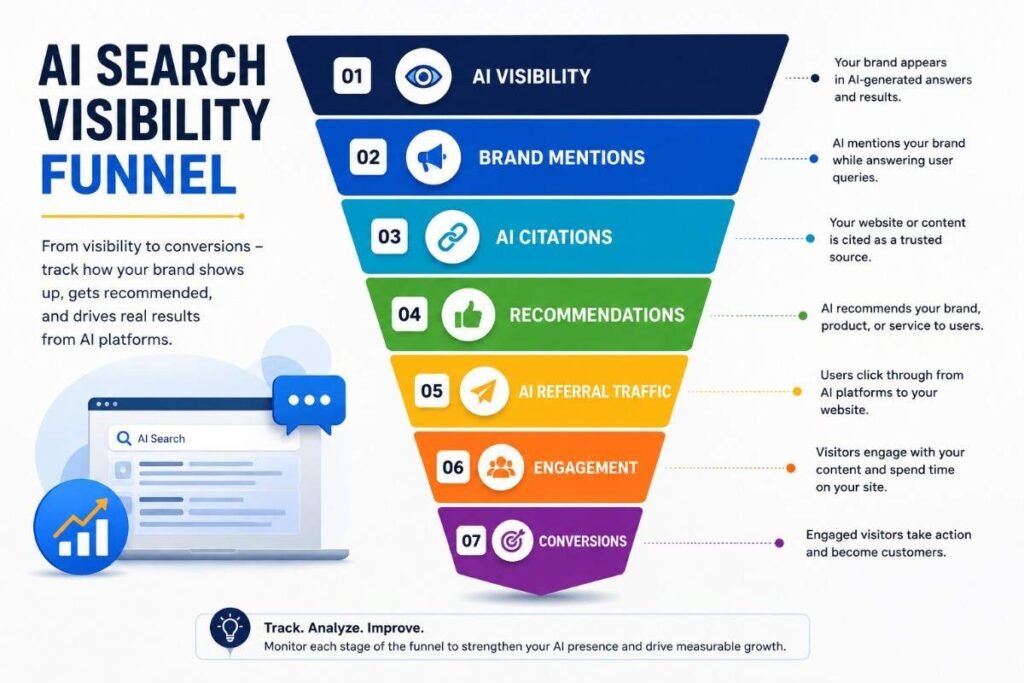
Each stage below naturally holds fewer entries than the one above it — that drop-off is expected. What matters month over month is whether the rate of drop-off between stages is improving, not the raw counts alone.
How to Track AI Search Performance, Step by Step
Step 1: Create a Prompt Library
Build 20–50 prompts that reflect how real customers actually ask questions, spread across categories: informational (“how do I choose a website developer”), commercial (“best digital marketing agency for small businesses”), comparison (“agency vs. freelancer for SEO”), local (“digital marketing agency in Dehradun”), category-level, branded, and problem-solving prompts. Reusing the exact same list every month is what makes the trend data meaningful.
Step 2: Test Multiple Platforms
Run the same prompt library across ChatGPT, Gemini, Google’s AI features, and Perplexity. Results genuinely differ between platforms — as the citation-count gap between ChatGPT and Gemini shows — so testing only one gives a partial and potentially misleading picture.
Step 3: Record Results
A simple tracking sheet works fine to start:
| Date | Platform | Prompt | Mention | Citation | Recommendation | Competitor Named | URL Cited |
|---|---|---|---|---|---|---|---|
| Aug 2026 | ChatGPT | Best digital marketing agency for small businesses | Yes | Yes | Yes | Agency A | example.com |
| Aug 2026 | Gemini | Digital marketing agency in Dehradun | Yes | No | Yes | Agency B | competitor.com |
Step 4: Connect With Analytics
Pull whatever AI-attributed data the GA4 property and Search Console will give — AI Assistant channel sessions, landing pages, engagement, and any conversion events tied to those sessions. Cross-reference this against the mentions and citations logged manually; the two data sets tell different halves of the story.
Step 5: Compare Month Over Month
One month’s results are close to noise — AI answers change between sessions and model updates. Trends across three or more months are what can actually be acted on.
Traditional SEO vs. AI Search
| Traditional SEO | AI Search |
|---|---|
| Keyword rankings | Prompt visibility |
| SERP position | AI answer inclusion |
| Search impressions | Mentions / citations |
| Organic clicks | AI referral traffic |
| Click-through rate | Engagement rate |
| Backlinks | Source / entity authority |
| SERP features | AI recommendations |
None of this replaces SEO fundamentals — it sits on top of them. Crawlability, genuinely useful content, sensible internal linking, structured markup, and demonstrated authority are still what makes a page eligible to be pulled into an AI answer in the first place. AI search optimization is really an extension of good SEO practice, applied to a new set of surfaces, rather than a separate discipline that replaces it.
Measuring This for a Local Service Business Like MarkMyBiz
MarkMyBiz is a Dehradun-based agency offering website development, SEO, digital marketing, and graphic design — the kind of local service business where AI search visibility is becoming a real discovery channel alongside traditional local search.
A relevant prompt panel for a business like this would include category-level questions (“best digital marketing agency in Dehradun,” “affordable website development for small business,” “SEO agency near me”), comparison questions (“agency vs. freelance web developer”), and service-specific questions tied to its actual offerings.
To be clear: this article isn’t claiming MarkMyBiz currently appears, is cited, or is recommended in ChatGPT, Gemini, or any AI Overview — that would need to be verified against the seven measures above before anyone could say so honestly. What the framework gives a business like this is a concrete starting point: build the prompt panel, run it monthly, log what comes back, and track the trend rather than assuming the answer either way.
Frequently Asked Questions
How can I tell if ChatGPT mentions my brand?
There’s no built-in dashboard for this — you have to ask ChatGPT your prompt panel directly and record the results yourself, since responses vary by session and can’t be pulled from an API log the way search rankings can.
How do AI citations affect website visibility?
A citation includes an actual link to your page, which can drive both referral traffic and a trust signal to the model about your content’s reliability. A mention without a citation gives brand exposure but no direct path back to your site.
What is the difference between an AI mention and an AI citation?
A mention names the brand with no link. A citation includes a clickable URL pointing to the actual page. They’re tracked separately because one can happen without the other.
How often should AI search performance be measured?
Monthly, using the same prompt set each time. AI answers vary enough between sessions that a single check is closer to a snapshot than a trend — several months of consistent data are needed before drawing conclusions.
What are the most important AI SEO metrics?
Citation share (how often a brand is cited across its prompt category), mention accuracy, AI referral traffic and its conversion rate, and share of voice against named competitors. Together they cover discovery, accuracy, traffic impact, and competitive standing.
Sources & References
- Google for Developers — AI Features and Your Website
- CMSWire — Google Search Console Gets AI Overviews Data (June 2026)
- Semrush — 2026 AI Visibility Index
- Data-Mania — AI Search Visibility Benchmarks 2026
- The Smarketers — How to Measure AI Search Visibility
- AirOps — How to Measure AI Search Visibility
- AuthorityTech — AI Traffic Attribution: Tracking ChatGPT, Perplexity, Gemini
- MarTech — How GA4 Records Traffic from Perplexity Comet and ChatGPT Atlas