Your website can look stunning and be packed with great content, but if search engines can’t crawl it efficiently and visitors can’t find what they need in a few clicks, none of that matters much. This is the quiet, often-overlooked discipline of website architecture for SEO — and it’s the foundation that decides whether your pages rank, get indexed properly, or get ignored altogether.
After structuring and auditing hundreds of business websites across industries, we’ve noticed one pattern repeat itself at our website development service in Dehradun: sites with a clean, logical structure consistently outrank competitors who have better content but messier architecture. In this guide, we’ll break down exactly how website structure influences both your search rankings and your visitors’ experience — and what you can do about it.
What Is Website Architecture for SEO?
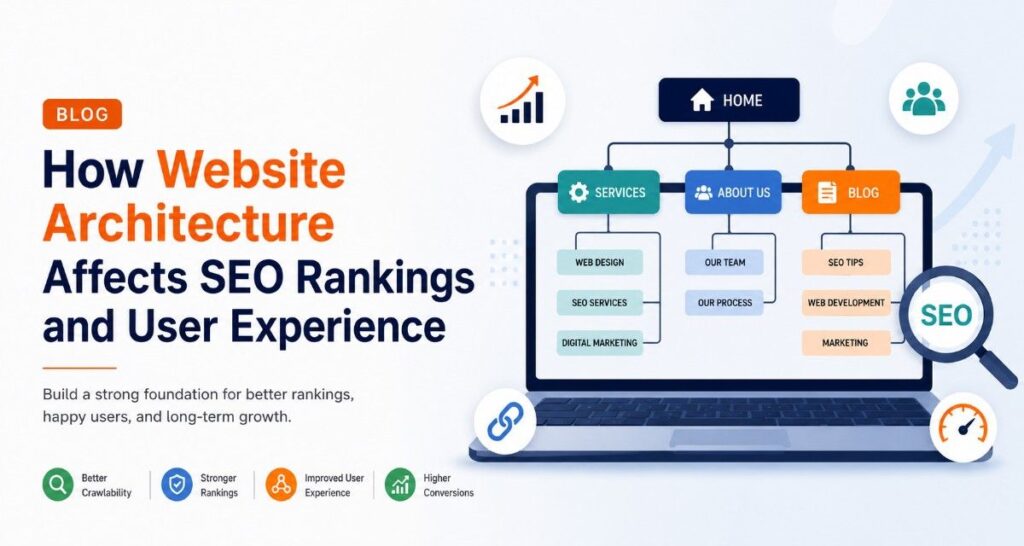
Website architecture refers to how your pages are organised, categorised, and connected to one another. Think of it as the blueprint of your site: which pages sit under which categories, how deep a visitor (or a search engine bot) has to dig to find a specific page, and how internal links tie everything together.
A well-planned architecture does two jobs at once. It tells search engine crawlers which pages matter most and how they relate to each other, and it guides real visitors toward what they came for — whether that’s a service page, a product, or a contact form. When both goals are addressed in the same structure, you get an SEO optimized website architecture that performs well in search results and converts visitors once they land there.
Why SEO Optimized Website Architecture Directly Impacts Your Rankings
Search engines rarely evaluate a page in isolation — they look at how it fits within your entire site. Three architecture-related factors carry real ranking weight:
Crawl Efficiency
Every website has a limited “crawl budget” — the number of pages search bots will crawl in a given visit. A flat, well-linked structure helps bots discover and index your important pages quickly. A deep, tangled structure wastes crawl budget on low-value pages while your money pages stay unindexed for weeks.
Link Equity Distribution
Internal links pass authority between pages. When your homepage links to category pages, which link to relevant service or product pages, authority flows logically through the site. Orphaned pages — ones with no internal links pointing to them — rarely rank, no matter how good the content is.
Page Speed and Core Web Vitals
Architecture isn’t only about hierarchy; it’s also about how cleanly your code, templates, and assets are organized. Bloated, poorly structured templates slow load times, and page experience metrics are a known ranking factor.
Get these three right, and you’ve built the technical backbone of a genuinely SEO friendly website structure that search engines can trust.
Core Elements of an SEO Friendly Website Structure
Every high-performing site we’ve built shares a few non-negotiable structural traits:
- A shallow hierarchy. Aim for every page to be reachable within three clicks from the homepage — categories, then subcategories, then individual pages, without unnecessary intermediate layers.
- Clean, descriptive URLs. A URL like /services/website-development tells both users and crawlers exactly what to expect, which is far more useful than a string of IDs or parameters.
- Strategic internal linking. Related pages should link to each other in context, not just through the main navigation. Local relevance plays a role here too — our complete local SEO guide for Indian businesses covers how internal linking ties into local search visibility.
- Clear navigation and breadcrumbs. Breadcrumbs aren’t decorative — they reinforce hierarchy for both users and search engines.
- An updated XML sitemap and robots.txt. These files explicitly tell search engines what to crawl and what to skip, preventing wasted crawl budget on admin pages, filters, or duplicate content.
- Mobile-first, responsive templates. With most search traffic coming from mobile devices, architecture has to perform identically on a phone screen as it does on a desktop.
SEO Friendly Website Structure for Business Websites: What Actually Works
Generic advice about site structure only goes so far — the right architecture depends on what kind of business you run.
For service-based businesses, a flat structure with one dedicated page per core service (rather than burying every service under a single “Services” page) consistently performs better, since each page can target its own keyword cluster.
For e-commerce stores, the category-to-subcategory-to-product hierarchy needs to be airtight, with faceted navigation handled carefully so filters don’t generate thousands of thin, duplicate URLs.
For local businesses, location-specific pages and consistent business information across the site matter just as much as the navigation itself — something we covered in detail in our piece on NAP consistency and user experience for local SEO.
Whatever your industry, the underlying principle of SEO friendly website structure for business websites stays the same: organise content around what your customers are searching for, not around your internal company structure. We’ve applied this exact approach while designing websites that convert visitors into customers across real estate, healthcare, travel, and education clients.
How Poor Website Architecture Hurts User Experience
Architecture problems that hurt SEO almost always hurt user experience too — the two are rarely separate issues.
A confusing navigation menu forces visitors to hunt for information, increasing bounce rate. Deeply buried pages get fewer clicks even when they’re exactly what a visitor was looking for. Broken internal links and inconsistent page templates erode trust, especially on mobile, where every extra tap or slow-loading screen increases the chance someone leaves. Over time, these friction points show up in analytics as lower dwell time and lower conversions — and eventually, lower rankings, since search engines do factor in user engagement signals.
This is exactly why architecture decisions shouldn’t be left until after a site is “designed.” Structure has to be planned first, with design and content built around it.
Building SEO Friendly Website Development From the Ground Up
If you’re building a new site or restructuring an existing one, here’s the sequence worth following on every project:
- Map keywords to pages first. Before any wireframe is drawn, identify what your audience searches for and assign each meaningful search intent its own page.
- Sketch the sitemap before the design. A simple hierarchy diagram prevents the common mistake of designing pages first and forcing structure around them later.
- Build clean URL and navigation logic. Decide URL conventions, folder depth, and menu structure before development begins.
- Implement technical SEO foundations. XML sitemaps, robots.txt, canonical tags, and schema markup should be part of the build, not an afterthought bolted on at launch.
- Audit and refine continuously. As you add pages, regularly review for orphaned content, broken links, and crawl errors.
This is exactly the kind of structured, SEO Friendly Website Development process our team follows on every project, regardless of the platform — WordPress, custom CMS, or static builds. We’ve documented this approach further in our piece on bespoke website development in Dehradun.
Why You Should Hire the Best Website Developer in Dehradun
A developer who only thinks about visual design will hand you a site that looks good on launch day and struggles in search results six months later. What you actually need is a team that treats architecture, SEO, and design as one connected system from day one.
That’s the approach we’ve built our practice around at MarkMyBiz. With an experienced team serving businesses across Dehradun and beyond, we plan site structure alongside digital marketing strategy so that every page you launch is built to rank, not retrofitted afterward. If you’re planning a new website or want an architecture audit of your existing one, get in touch with our team — we’ll show you exactly where your current structure is helping or hurting you.
Conclusion
Website architecture is the part of SEO that’s easy to overlook because it doesn’t show up in a content calendar or a keyword list — but it determines whether everything else you do even gets a fair chance to rank. A clean, SEO optimized website architecture makes your site easier for search engines to crawl, easier for visitors to use, and easier for your business to grow. Get the structure right, and rankings and user experience improve together, not at each other’s expense.
Frequently Asked Questions
What is the difference between website architecture and website design?
Website design focuses on visual elements such as colour, layout, and typography. Website architecture is the underlying structure — how pages are organised, categorised, and linked. Strong design without solid architecture often still struggles to rank.
How many clicks should it take to reach any page on my website?
As a general rule, every important page should be reachable within three clicks from the homepage. Pages buried deeper are crawled less often and receive less internal link equity.
Does website architecture affect mobile SEO too?
Yes. Since Google primarily uses mobile-first indexing, your site’s structure, navigation, and internal linking need to work just as well on mobile devices as they do on desktop.
Can I fix my website’s architecture without a full redesign?
In most cases, yes. Restructuring internal links, cleaning up URL patterns, updating the sitemap, and reorganising navigation can often be done without rebuilding the site visually.
How long does it take to see SEO improvements after restructuring a website?
Most businesses see crawling and indexing improvements within a few weeks, with ranking improvements typically becoming visible over two to three months as search engines re-evaluate the updated structure.