Two businesses, same city, roughly the same customers, roughly the same price point. One of them has a website that loads before you’ve even finished reading the URL, remembers what you looked at last time, and answers a question through a chat widget at 11 p.m. on a Sunday. The other one looks fine too, technically. Except it treats a first-time visitor exactly the same as someone who’s bought from them five times already.
Which one do you think gets the sale?
That’s basically the entire argument for AI-Powered Website Development in one example. It isn’t about chasing a trend because everyone’s suddenly talking about it. Customer expectations have shifted, search engines have shifted, and now even ChatGPT and Google’s AI Overviews are changing how a website gets found in the first place. Businesses that haven’t caught up are losing ground, whether or not anyone’s pointed it out to them yet.
So here’s what this guide actually gets into: why AI matters for business right now, what people actually mean by the “30% rule,” and how AI-Powered Web Design is rewriting what a “good website” is even supposed to look like.
Short answer, if you’re skimming:
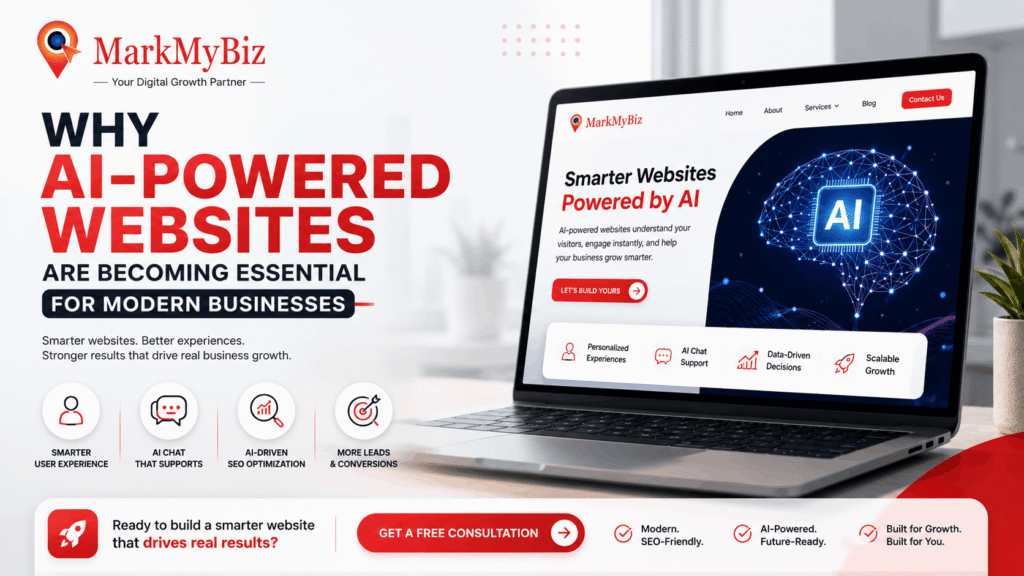
AI-Powered Website Development matters because your site can personalize itself for each visitor, answer questions without a person on the other end, catch its own SEO issues, and handle a traffic spike without falling over. A static, traditionally-built site just can’t keep pace with any of that.
Why Is Artificial Intelligence (AI) Important in Modern Business?
Artificial intelligence isn’t important because it’s clever. It’s important because, in a lot of cases, it does the unglamorous parts of running a website faster and cheaper than a person would. Strip away the hype and you’re left with a few practical reasons this actually matters.
It Shortens the Distance Between a Question and an Answer
Nobody waits around anymore. Someone lands on your site wondering about pricing, or whether you even serve their city, and if there’s no answer within a few seconds, they’re gone. An AI chat assistant handles that at 2 a.m. on a Sunday without anyone on your team lifting a finger. Compare that to a contact form that gets a reply on Monday afternoon. By then, that visitor has usually already filled out a form on somebody else’s site.
It Replaces Guesswork With Data
Most websites still run one version for every single visitor: same homepage, same offer, same layout, whether you’ve never heard of the business or you’ve bought from them three times. An AI-driven website development approach flips that. It watches what people click, where they stall, what they scroll past without reading, and nudges the page toward whatever’s actually working. Instead of a hunch about what your business website development strategy should be, you end up with something closer to evidence.
It Protects Margins as You Grow
If your traffic doubles and your support headcount has to double along with it, something in that setup is broken. That’s the real appeal of an AI-Powered Website Development Service: the routine stuff, FAQ handling, basic lead sorting, flagging a page that’s gone slow, gets handled without payroll rising to match.
Why Is AI Becoming Essential for Today’s Time?
There’s “AI is a nice tool to have,” and there’s “AI is becoming essential,” and those are two different claims. The second one has really only become true in the last couple of years, for three fairly specific reasons.
Search Itself Has Changed
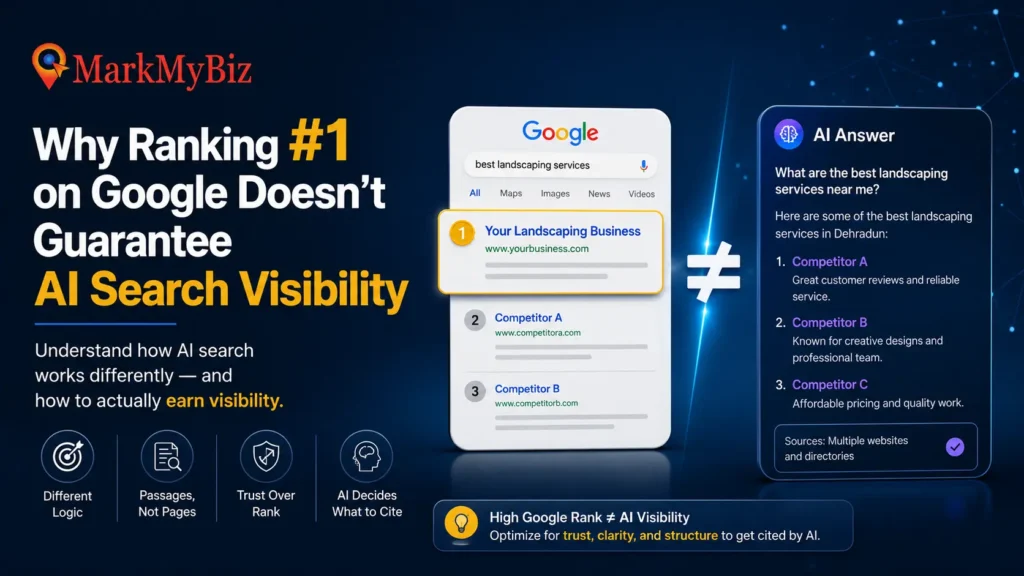
Google’s AI Overviews, along with ChatGPT and Perplexity, now answer a lot of questions directly, no click required. Ahrefs looked at roughly 300,000 keywords and found that once an AI Overview appears above a result, click-through on the top organic listing can drop sharply. A page that isn’t built to be picked up by these systems, clear headings, real schema markup, content that actually answers something, simply doesn’t show up for a growing share of searches anymore. That’s the whole idea behind AEO and GEO: writing so a human and an AI model both come away understanding, and trusting, what the page is telling them. Google itself has more or less said that optimizing for AI search is just solid SEO, done properly.
Customers Now Expect a “Smart” Experience by Default
Anyone who’s used Amazon or Spotify has already been trained to expect a site that responds to them. So when a small or mid-sized business website doesn’t do any of that, doesn’t remember, doesn’t adjust, it can come across as a little behind the times, even when the business itself is doing everything right.
Competitors Are Already Doing It
A good chunk of technology and software companies are already reporting measurable revenue gains from AI, according to recent industry research. Once enough of your competitors have moved to Professional website development services built around this, sitting it out stops being a neutral choice. It’s just falling behind at a slower pace.
What Is the 30% Rule in AI?
You’ve probably run into the “30% rule” if you’ve read anything about AI for business lately. It gets tossed around like it’s some official standard. It isn’t, really. It’s more of a working guideline that caught on across product, marketing, and development teams because it’s a decent bit of shorthand.
The most common version goes like this: AI can be trusted with roughly 70% of the repetitive, data-heavy work, first drafts, testing, data entry, initial content passes, while the other 30% stays with a person. That 30% covers pretty much everything AI still struggles with: judgment calls, brand voice, ethics, actual creative direction.
| What AI Handles (~70%) | What Stays With People (~30%) |
| First drafts of content and code scaffolding | Final editorial judgment and brand voice |
| Routine testing and bug-catching | Brand strategy and client relationships |
| Chatbot answers to routine questions | Ethical and compliance calls |
| Performance and SEO monitoring | Creative direction and final sign-off |
Why the 30% Rule Matters for Your Website
Here’s how it lands directly on AI-Powered Website Development: if an agency tells you the AI handles everything and nobody double-checks it, that’s worth raising an eyebrow at. Not because AI does bad work, but because unchecked AI output drifts, it gets the brand voice slightly off, states something that isn’t quite right, makes an SEO call that doesn’t hold up under scrutiny. Good AI-Powered Web Design still has a person reading the page before it goes live, making sure it sounds like your business rather than a template that’s been reused a few hundred times already. That’s really all the 30% rule is pointing at: AI and human judgment work better as a pair than either one does solo.
How Does AI Web Design Help With Modern Websites?
AI-Powered Web Design isn’t one single feature you switch on. It’s a handful of things running quietly in the background. Roughly, here’s what that tends to look like:
- Personalization that used to need a whole custom build. A returning visitor sees a different homepage, a different offer, and nobody touched a line of code to make that happen. Used to require a custom CMS project. Now it’s mostly automatic.
- Cleaner code, built faster. AI tools scaffold out components and catch the obvious bugs early, which cuts down the dead time between “we have an idea” and “the page is actually live.”
- SEO that flags its own problems. An SEO-friendly AI website can spot thin content, a missing alt tag, a dead internal link, a page that’s gotten sluggish, without waiting on a quarterly audit to catch it. Our piece on building an SEO-friendly website covers the groundwork all of this sits on top of.
- Someone answering at 3 a.m. AI chat handles the routine questions, hours, pricing, availability, so your team isn’t stuck typing “our hours are 10 to 7” for the tenth time this week.
- Room to grow without the panic. Scalable website development means the site expects a spike, a festive sale, a mention somewhere, and just absorbs it instead of buckling at the worst possible moment.
- SEO that never really wraps up. AI website optimization means the page keeps testing headlines and structure against what’s actually converting, instead of being a project that gets closed out and forgotten.
Put all of that together and you can see why businesses are starting to treat an AI-Powered Website Development Service less like a vendor they hired once, and more like an ongoing part of the team.
Real-World Problems an AI-Powered Website Actually Solves
It’s easy to talk about AI in the abstract. Here’s what it actually looks like when it’s solving a problem somebody’s genuinely dealing with.
- “Our website looks fine, but the leads just aren’t converting.” AI-driven visitor tracking can show you exactly where people bail, a confusing form, a slow checkout, a page that skips the one question buyers actually have, so you’re fixing the real problem instead of guessing at it. If page speed’s part of the issue, our guide on boosting website page loading speed walks through the fixes that actually move the needle.
- “We can’t keep up with customer messages.” A chatbot trained on your actual FAQs can knock out the routine questions instantly, which frees your team up for the conversations that genuinely need a person.
- “Our site still looks like it did five years ago.” A rebuild on modern, mobile-friendly foundations tends to beat an old site that’s just had a fresh coat of paint slapped on it. Our post on website development trends gets into what’s shaping the next few years.
- “We rank fine on Google, but ChatGPT and AI Overviews never bring us up.” That’s usually a structure problem, clear headings, FAQ schema, content that actually answers the question being asked. Our post on how semantic HTML boosts responsive design and SEO goes deeper into the technical side.
- “Our website can’t handle a traffic spike without crawling to a stop.” This is exactly where Scalable website development earns its keep, cloud infrastructure that expands on its own instead of buckling under pressure.
How to Choose the Right AI-Powered Website Development Service
Not every agency that says “AI” is actually building anything different. When you’re sizing up an AI-Powered Website Development Service, a few questions tend to separate the real thing from the sales pitch:
- Can they show you something real, not just tell you about it? Ask to see a live site or chatbot they’ve actually built, not a slide with stock screenshots.
- Do they talk about SEO and AEO/GEO in the same breath? A genuinely SEO-friendly AI website needs to work for human searchers and AI-generated answers both, not just whichever one’s easier to sell.
- Is a person actually checking the output? Going back to the 30% rule, ask how much of the writing, design, and QA gets human eyes on it versus running fully on autopilot.
- Does it hold up at ten times the traffic? A Scalable website development plan should say what happens well past your current numbers, not just describe how the site looks on launch day.
- What happens after it’s live? AI-driven website development isn’t something you build once and walk away from. Retraining the chatbot, refreshing content, keeping an eye on performance, that’s the actual job, not an afterthought.
At MarkMyBiz, our website development service is built around exactly that balance, AI doing the heavy lifting on speed and personalization, with an experienced Dehradun-based team actually reading every page before it goes live. If you want a sense of who’s behind the work, our about page has more on the team.
Common Mistakes Businesses Make When Adopting AI for Their Website
Worth being upfront here, because not every AI website project goes the way it’s pitched.
- Automating everything at once. Hand 100% of the content, design, and customer conversations over to AI overnight, and you usually end up with something that reads generically and occasionally gets a fact wrong. The 70/30 split exists for a reason.
- Not caring about data quality. AI personalization is only as sharp as the behavioural data behind it. Feed it messy analytics and it optimizes off bad information, confidently.
- Assuming AI replaces SEO basics. Fast pages, mobile-friendly design, clean navigation, content that’s genuinely useful, none of that goes away. AI sits on top of that foundation. It doesn’t substitute for it.
- Skipping the human review step. Brand voice, factual claims, anything compliance-related, someone needs to read it before it goes live. Every time.
- Expecting results overnight. Research on AI adoption keeps pointing the same way, returns usually take longer to show up than people expect, and rushed rollouts without a clear goal tend to disappoint. Knowing what you actually want, more leads, faster replies, better conversion, matters more than just having “AI” somewhere on the site.
Final Thoughts: Is Your Website Ready for the AI Era?
AI-Powered Website Development was never about replacing the judgment and relationships that actually built your business. It’s closer to giving your website the same instincts your best salesperson already has, noticing what someone needs, responding right away, and getting a bit better with every interaction.
If your site still treats every visitor identically, takes its time loading, or never comes up when someone asks ChatGPT or Google’s AI Overview a question about your industry, that’s usually the sign. Not that you need a redesign for the sake of it, but one built around how people, and increasingly AI, actually search and shop now.
MarkMyBiz has spent years building Professional website development services for businesses across healthcare, real estate, travel, e-commerce, and a fair bit more. If you want to talk through what an AI-powered, SEO-friendly site could look like for your business, get in touch with our team. We’re based in Dehradun, and we build for businesses well beyond it.