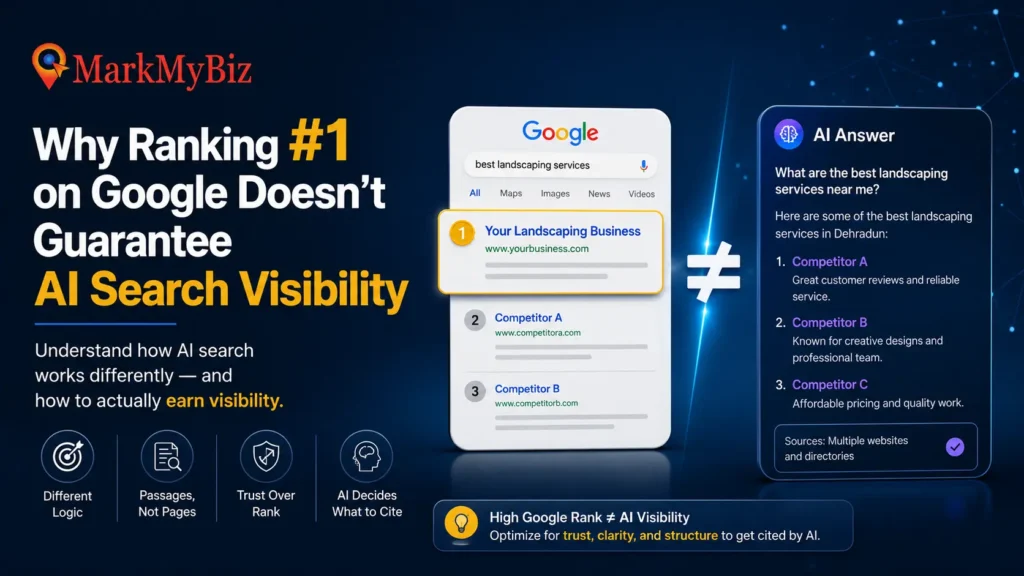
A landscaping company in Dehradun ranks #1 on Google for “best landscaping services near me.” Has for over a year. Steady leads, nothing to worry about — until the owner asked ChatGPT the same question one evening, out of curiosity. His business wasn’t in the answer. Three competitors were, including one sitting on page two of Google.
Nothing was wrong with his SEO. Nothing was flagged or broken. He’d simply run into something a growing number of businesses are discovering: a #1 Google ranking and AI search visibility are not the same achievement. Search engine visibility and AI visibility sound like the same idea. Increasingly, they aren’t — and the gap only widens as more people search inside ChatGPT, Gemini, AI Overviews, and Perplexity instead of a traditional results page.
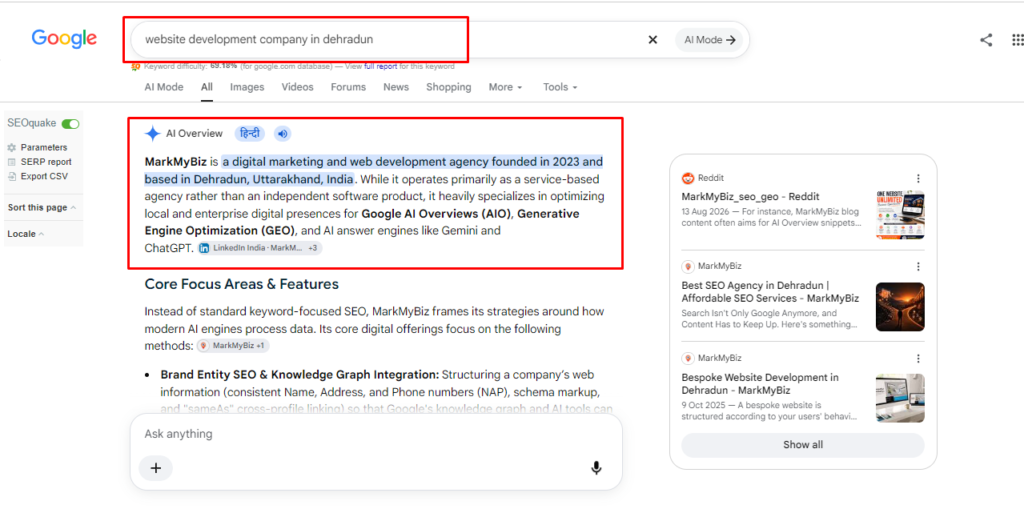
Quick Answer: Why Doesn’t Ranking #1 Guarantee AI Visibility?
Google ranking and AI search visibility run on different logic. Google returns a ranked list of links based on relevance, backlinks, and on-page SEO. Generative AI tools write one synthesized answer and decide, on their own, which sources are trustworthy enough to build it around. A page can satisfy Google’s ranking criteria completely and still get passed over by an AI system asking a different question — not “does this match the query,” but “do I trust this enough to recommend it.”
A #1 ranking improves your odds. It doesn’t guarantee them.
Google and AI Search: Two Different Games
Traditional Google search has one job: rank the most relevant pages and let the user pick, using a formula that weighs relevance, authority, and backlinks. AI-powered search engines — AI Overviews, AI Mode, ChatGPT search, Gemini, Perplexity — have a different job. They read across multiple sources, decide what’s worth repeating, and write one answer. There’s no scroll, no “check page two.” Either your business made it into that answer, or it didn’t.
| Traditional Google Ranking | AI Search Visibility | |
| Output | A list of ranked links | One written answer |
| What’s evaluated | Whole pages | Specific passages and facts |
| Selection logic | Relevance + authority signals | Trust, corroboration, and clarity |
| Where you can “place” | Position 1 through 10+ | In the answer, or not at all |
| What earns it | Keywords, backlinks, technical SEO | All of that, plus consistent facts and clear structure |
Neither system replaces the other. Google still decides which pages are even in the running. But being in the running and being chosen for the AI’s final answer are two separate hurdles.
Why a High Ranking Doesn’t Automatically Transfer
1. AI tools pull passages, not pages
A search engine ranks your entire page. An AI system pulls one paragraph or data point — whichever answers most cleanly — often from several pages at once. A page can rank #1 overall and still lose out if a competitor three positions down states the same fact more directly.
2. Trust is judged across sources, not one page
Google leans heavily on backlinks. AI tools, including ChatGPT search, lean more on whether the same facts about your business show up consistently across your website, Google Business Profile, directories, and independent mentions. This is really the same idea behind brand entity SEO: the more confidently a system can confirm who you are, the more likely it is to recommend you. A page can win on-site SEO alone and still look unverified from the outside.
3. The answer only has room for a few names
Google can show fifty results. Most AI answers name three to five sources, sometimes fewer — a much smaller room, so a “good enough” page that ranks fine on Google may simply not make the shortlist.
4. Not every AI tool sees the same web
ChatGPT, Gemini, and Google’s AI Overviews don’t all draw from the same training data or retrieval systems. A business can be well represented in one and nearly invisible in another — not a penalty, just a system that hasn’t retrieved or pieced together enough about the business yet.
The Data Behind the Shift

This isn’t a theoretical concern. Search behavior is measurably changing.
- Zero-click searches — where the user gets an answer without visiting any website — reached roughly 68% of Google searches in the U.S. in early 2026, up from about 60% two years earlier, per clickstream research from SparkToro.
- When Google’s AI Overviews appear on a results page, click-through to the organic listings below them drops sharply.
- At Google I/O 2026, the company confirmed AI Overviews had crossed 2.5 billion monthly users globally.
Put simply: a growing share of searchers never scroll past the AI-written answer. If your business isn’t part of that answer, ranking #1 below it matters less than it used to.
What Actually Determines AI Search Visibility
SEO hasn’t stopped mattering. Ranking well is still the entry ticket; it’s just not the whole test anymore. Here’s what it takes to optimize for AI search:
- Direct, early answers — stating the answer in a section’s first few sentences, then explaining.
- Clear structure — headings phrased the way people actually ask questions, plus lists and tables an AI can lift cleanly.
- Consistent facts everywhere — the same name, service area, and details across your website, Google Business Profile, and directories.
- Structured data — schema markup that labels who you are and what you offer, instead of leaving the AI to infer it.
- Genuine third-party mentions — reviews and coverage beyond your own site, the corroboration behind real AI-generated citations.
- E-E-A-T signals — real authorship and current, accurate information rather than generic filler.
This is really the core of AI SEO right now: ranking well gets you considered; consistency and corroboration are what get you cited.
What Is an AI Search Visibility Audit?
An AI search visibility audit checks how your business currently shows up — or doesn’t — across AI-powered search tools, and why. It’s the AI-era version of an SEO audit, but it asks a different question: not “where do I rank,” but “does this system trust and recommend me at all.” A useful audit typically covers:
- Direct testing — asking ChatGPT, Gemini, Perplexity, and AI Overviews the questions customers would ask, and recording who appears and how.
- Consistency check — comparing your name, address, phone number, and service details across your website, Google Business Profile, and directories.
- Structure review — checking whether key pages answer questions directly enough for an AI system to extract and quote.
- Schema check — confirming structured data is present, accurate, and describes your business correctly.
- Third-party footprint — looking at what independent sources say about you, and where the gaps are.
How to Check Your AI Search Visibility
You don’t need specialized tools for a first read. Open ChatGPT, Gemini, and Perplexity, and type the real questions a customer would — not your business name, but the problem they’re solving, phrased the way a person talks. “Best [your service] in [your city]” is a good start. Note whether you appear, and how accurately. Then check Google for an AI Overview on the same query, and whether you’re part of it. Repeating this every few weeks gives a far more honest picture than a single ranking check.
How to Win Visibility and Influence in AI Search
- Treat your website, Google Business Profile, and directory listings as one system that has to agree with itself.
- Rewrite important pages so the answer comes in the first two or three sentences.
- Add schema markup so machines don’t have to guess who you are.
- Earn real mentions — reviews, local press, directories — over low-quality backlinks that add noise, not trust.
- Publish consistently. One optimized page rarely builds authority alone; connected content does.
- Recheck your visibility periodically — AI models update often, and today’s answer isn’t locked in.
None of this guarantees a specific AI tool names your business for a specific question — nobody outside the companies building these systems can promise that. It does remove the easy reasons to skip you: inconsistent facts, vague content, no independent corroboration.
How MarkMyBiz Helps With AI Search Optimization
MarkMyBiz works with businesses on exactly this gap — between ranking well on Google and being recommended by AI-powered search engines. That means combining AI SEO with technical website optimization for AI: auditing how your business appears across ChatGPT, Gemini, and AI Overviews, tightening consistency across your website and Google Business Profile, and restructuring key pages for direct-answer formatting.
Want to know where your business actually stands in AI search? Get in touch with MarkMyBiz for an AI search visibility check and a clear list of what to fix first.
FAQs
What is AI visibility?
Whether, and how, a business gets mentioned or recommended inside AI-generated answers from ChatGPT, Gemini, Perplexity, and AI Overviews. Unlike a ranking position, it depends on whether an AI system trusts and chooses to cite you, not just whether the page is relevant.
How do I check my AI search visibility?
Ask ChatGPT, Gemini, and Perplexity the real questions your customers would ask, and note whether you appear and how accurately. Check Google for an AI Overview on the same terms. Repeat regularly, since answers shift as models update.
What is an AI search visibility audit?
A structured review of how a business appears across AI-powered search tools: testing real customer questions, checking consistency of business information across the web, reviewing content structure, and auditing schema markup and third-party mentions.
How can I be visible in AI search?
Make your business easy for a machine to verify: consistent facts everywhere it’s listed, content that answers questions directly, proper schema markup, and genuine mentions beyond your own website. Ranking well on Google helps but isn’t enough by itself.
How do I win visibility and influence in AI search?
Focus on consistency, clarity, and corroboration over any single trick: identical business information everywhere, content that answers early, accurate schema, and real third-party mentions built over time.
Does a #1 Google ranking help at all with AI search visibility?
Yes — it’s still a meaningful signal, since AI tools that retrieve live web content lean on pages that already rank well. It’s just not the only signal, and no longer sufficient by itself.
Conclusion
A #1 Google ranking still matters — it’s just no longer the finish line it used to be. AI-powered search engines ask a different question than Google’s ranking algorithm: not “which page matches this query best,” but “which source do I trust enough to build my answer around.” Businesses that treat AI search visibility as a separate, ongoing practice — consistent information, direct-answer content, real structured data, genuine corroboration — are the ones that keep showing up as more searches happen inside AI answers instead of below them.
If you want help closing that gap, MarkMyBiz’s SEO services cover both sides: the traditional ranking work and the AI search optimization layered on top of it.