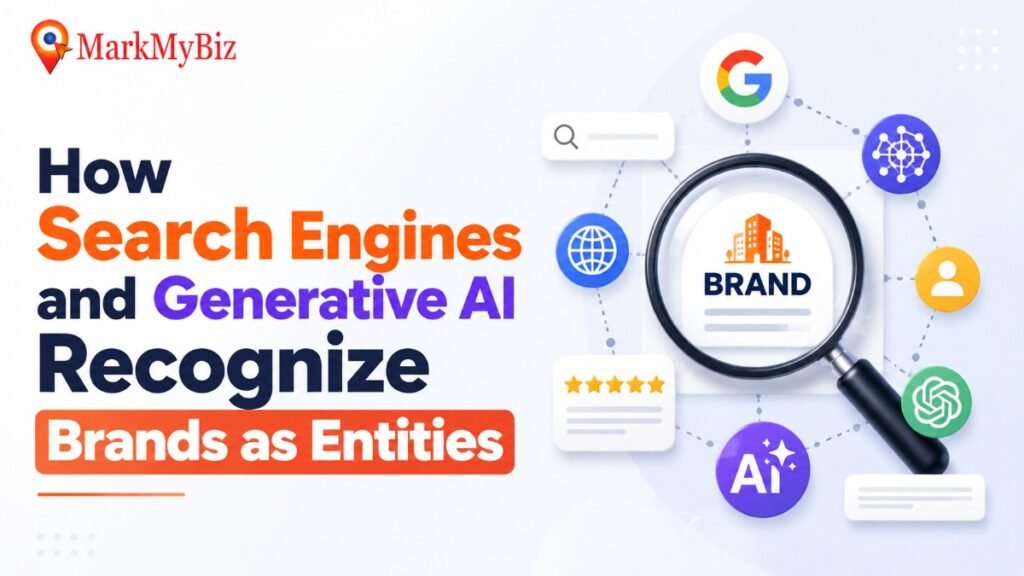
Here’s a strange but increasingly common situation: a business ranks on page one of Google, has for years, and still gets skipped over entirely when someone asks an AI tool the exact question that business answers best. It’s confusing until you realize what’s actually happening underneath. Search engines and AI systems stopped just matching words on a page a while ago. What they’re doing now is closer to figuring out who is talking — what the business is, what it actually does, and how it fits alongside everything else they already know.
SEO people call that “who” an entity. And getting a handle on how generative AI recognizes brands, versus how a traditional search index does it, is turning into one of those unglamorous-but-necessary skills for anyone trying to stay visible as search moves away from ranked blue links toward AI-written answers. This is really the whole premise behind Brand Entity SEO and Generative Engine Optimization (GEO) — not gaming a system, but making a brand clear enough that a machine can describe it correctly without guessing.
Quick Answer: How Search Engines and Generative AI Recognize Brands
Neither one relies on a single page. Both cross-reference a brand across many sources and try to see if the story holds together. That usually pulls from:
- What the business says about itself (website, About page, product pages)
- Structured data and schema markup
- Whether the name, location, and contact details actually match everywhere
- How other sites talk about and link to the brand
- Third-party references — directories, publications, review sites
- How the brand connects to everything around it: industry, location, people, products, affiliated organizations
When all of that lines up, a system can describe the brand with some confidence. When it doesn’t — when the name’s spelled two different ways, or the address on one site doesn’t match another — the system tends to just say less, or nothing at all, rather than risk being wrong.
What Is a Brand Entity?
A keyword, in SEO terms, is a string of text. An entity is an actual thing — a person, a place, an organization, a product — that a system can recognize as distinct from every other similar thing, even when it’s described in ten different ways across ten different sites.
A brand entity is how a search engine or AI system represents your business internally. Think of it as a node with attributes attached (name, category, location, founder, services) and connections running out to other nodes (an industry, a location, a set of competitors, a set of customers). That’s a different thing entirely from a brand mention, which is just the name showing up in text somewhere. You can get mentioned a thousand times and still never be recognized as a coherent entity, if those thousand mentions don’t agree with each other.
Take a bakery — call it Sunrise Bakery. It shows up on Instagram, gets listed in a local directory, picks up a few Google reviews. If the name, address, and category match across all three, a knowledge system can merge them into one confident record without much trouble. But if Instagram says “Sunrise Bakers,” the directory has an old address, and the Google listing skips the address altogether, the system is left guessing whether these are even the same business. Often, it just won’t bother guessing.
How Search Engines Recognize Brands as Entities
Search engines still crawl and index pages — that part hasn’t gone anywhere — but ranking systems now layer entity understanding on top of it. Roughly speaking: the crawler goes through a site, pulls out likely entities (organizations, people, places, products), and checks them against what it already knows from business profiles, structured data, and past crawls. From there it builds — and keeps updating — an internal record of what the entity is and how it connects to other things.
Google made this shift public back in 2012 with the Knowledge Graph, framed at the time as connecting “things, not strings.” That framing hasn’t really changed in the years since.
Worth being clear about one thing here: there’s no dashboard, no single “brand entity score” you can look up and optimize toward. It’s a layered process — crawl, extract, reconcile, build trust — and it plays out differently depending on the product (Search, Google Business Profiles, Shopping, Discover). It also gets stronger over time, as consistent and verifiable information piles up.
How Generative AI Recognizes Brands
This is where it gets genuinely different, and where a lot of businesses get caught off guard. Generative AI systems don’t all work the same way, so it’s worth resisting the urge to lump them together. Broadly, though, they’re drawing on some mix of:
- Training data — text the model learned from up to some cutoff date, which may or may not include much about your brand
- Retrieval — a lot of AI search tools (Google AI Overviews, ChatGPT Search, Perplexity, and others) actually go out and search the live web when answering, rather than working purely from memory
- Structured and semantic signals — schema, consistent naming, clear relationships that help the system figure out which brand a query is actually pointing at
- The prompt itself — the specific wording, location, and intent behind what someone typed
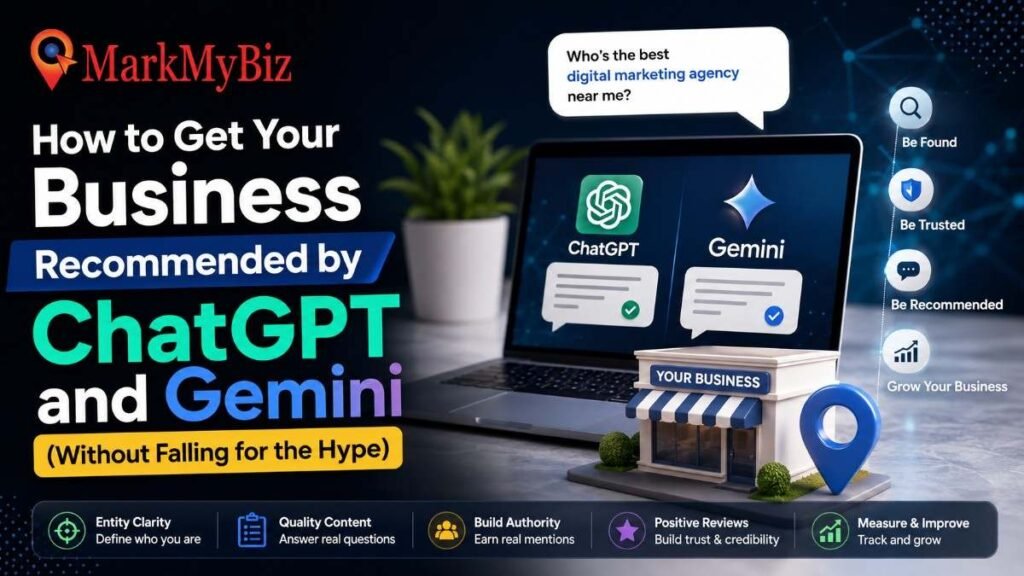
Here’s the real dividing line between the two systems: a search engine mostly ranks and returns pages that already exist. A generative AI system writes an answer from scratch and decides, on its own, which sources and which brands are worth including in that answer. So a brand can be doing perfectly well in traditional search rankings and still get left out of an AI answer entirely — because the AI isn’t asking “which page best matches this query,” it’s asking something closer to “do I trust this source enough to build my answer around it.”
And because the underlying architectures, training data, and update schedules differ from tool to tool, visibility swings a lot between them. A brand can show up clearly in one AI tool’s answers and be essentially absent from another’s — not because of some penalty, but because that particular model hasn’t retrieved, trained on, or pieced together the brand’s information yet.
The Role of Entity Relationships in Search
Brands are almost never understood on their own. Confidence comes from context — from a web of connections that looks something like this:
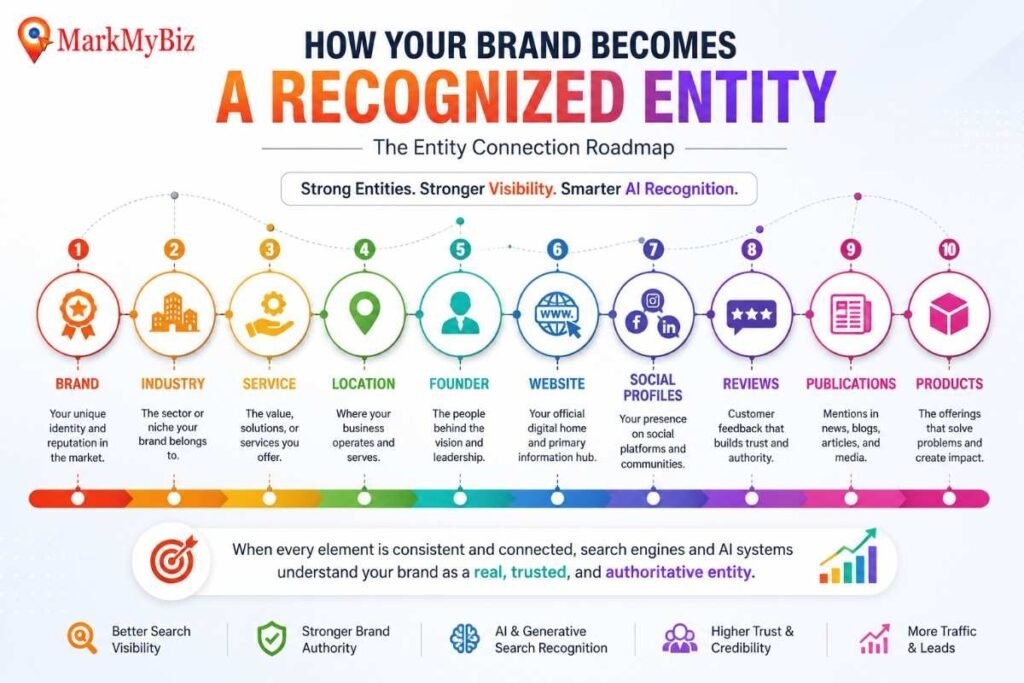
Brand → Industry → Service → Location → Founder → Website → Social Profiles → Reviews → Publications → Products
Every one of those links helps a system tell the brand apart from other similarly named ones, and helps it figure out what the brand is actually relevant for. A physiotherapy clinic that’s clearly tied to “physiotherapy,” a specific city, a named practitioner, and a real set of patient reviews is much easier to place confidently than one that’s just a homepage sitting by itself with nothing pointing to it.
This is also why relationships tend to matter more than raw mention count. A handful of well-connected, accurate references usually does more for a brand’s clarity than fifty scattered, disconnected ones ever will.
Why Consistent Brand Information Matters
At the core of all this, both search engines and AI systems are trying to stitch together information from a lot of different places into one coherent picture. Inconsistency just makes that harder — and uncertain systems tend to go quiet rather than guess out loud. The usual culprits:
- Name variations across platforms — abbreviations, punctuation, an old name that never got fully retired
- Addresses or phone numbers that are outdated in one place and current in another
- Business descriptions that don’t quite match between the website, the Google Business Profile, and social platforms
- Founder or author names spelled differently depending on where you look
- Old directory listings nobody updated after a rebrand
None of this has to be flawless to work. But when the core facts — name, category, location, what the business actually does — agree across the website, the Business Profile, social platforms, and any directories, systems can merge those references with a lot more confidence than they’d otherwise have.
How Brand Mentions and Authoritative Sources Support Entity Recognition
Not every reference to a brand carries the same weight, and it helps to separate a few things that get lumped together:
- Brand mentions — the name appearing in text, linked or not
- Backlinks — an actual hyperlink from another site
- Citations — structured references common in local SEO (name, address, phone number)
- Editorial references — a publication independently covering or reviewing the brand
- Reviews — user-generated feedback on Google, directories, or marketplaces
A well-regarded publication writing about the brand, an accurate directory listing, and a genuinely detailed customer review can each add something different — but none of them automatically bumps rankings or earns an AI citation on its own. Source quality tends to matter more than volume. One mention in a respected, topically relevant outlet usually does more than a stack of low-quality directory submissions ever will.
The Role of Structured Data and Machine-Readable Information
Structured data — usually schema.org markup written as JSON-LD — gives search engines and AI systems an explicit description of a page, instead of one they have to infer from whatever text happens to be visible.
The types that matter most for brand entity recognition:
- Organization schema — name, URL, logo, description
- LocalBusiness schema — location, hours, service area, for anything with a physical footprint
- Person schema — founders, authors, key team members
- sameAs — links from Organization markup out to verified profiles: Wikipedia or Wikidata if one exists, official social accounts, other authoritative pages
Google’s own documentation doesn’t list any strictly required properties for Organization Schema markup — the guidance is really just “add what’s accurate and relevant,” usually on the homepage or an About page. And it’s worth saying plainly what structured data doesn’t do: Google’s general guidelines are explicit that structured data affects eligibility for certain rich results, not rankings in web search. It helps machines read a page with more confidence. It doesn’t, on its own, guarantee rankings, AI visibility, or citations.
For businesses without an in-house dev team, this is usually where a website partner or an SEO-focused digital marketing service comes in — schema implementation almost always means editing site templates rather than tweaking individual pages one at a time.
Entity SEO vs Traditional Keyword-Focused SEO
| Dimension | Traditional Keyword SEO | Entity SEO |
|---|---|---|
| Core unit | Keywords and phrases | Named, disambiguated entities |
| Optimization target | Matching search query text | Matching real-world meaning and relationships |
| Content depth | Often single-topic, single-page | Topic clusters covering related concepts |
| Signals used | On-page text, backlinks | On-page text, structured data, entity relationships, cross-source consistency |
| Brand identity | Implied by content | Explicitly defined via schema and consistent information |
| AI search relevance | Indirect | Directly supports retrieval and citation |
These aren’t really competing approaches. Entity SEO sits on top of solid keyword and content work — it doesn’t replace it. A page still has to answer the question well. It also has to make clear which entities it’s about and how they relate to each other.
How Brand Entity SEO Can Improve AI Search Visibility
A consistent, well-connected entity tends to be easier for both search engines and AI systems to understand, which can make accurate citation more likely — though never guaranteed, and anyone who tells you otherwise is overselling it. The pieces that generally matter:
- Disambiguation — a distinct name, category, and location that keep the brand from getting confused with similarly named ones
- Context — clear ties to an industry, a service area, related topics
- Authority — mentions from sources that are themselves trusted on that topic
- First-party clarity — a website that says plainly who the business is, what it does, and who it’s for
- Third-party validation — independent confirmation of those same facts elsewhere
- Structural consistency — the same core facts, represented the same way, everywhere
None of this guarantees a specific AI tool cites a specific brand for a specific query — these systems weigh a lot of factors, and their behavior shifts every time the model gets updated. What a stronger entity profile actually buys you is a better foundation: fewer reasons for a system to hedge, skip, or get something wrong when your brand is genuinely relevant to what someone’s asking.
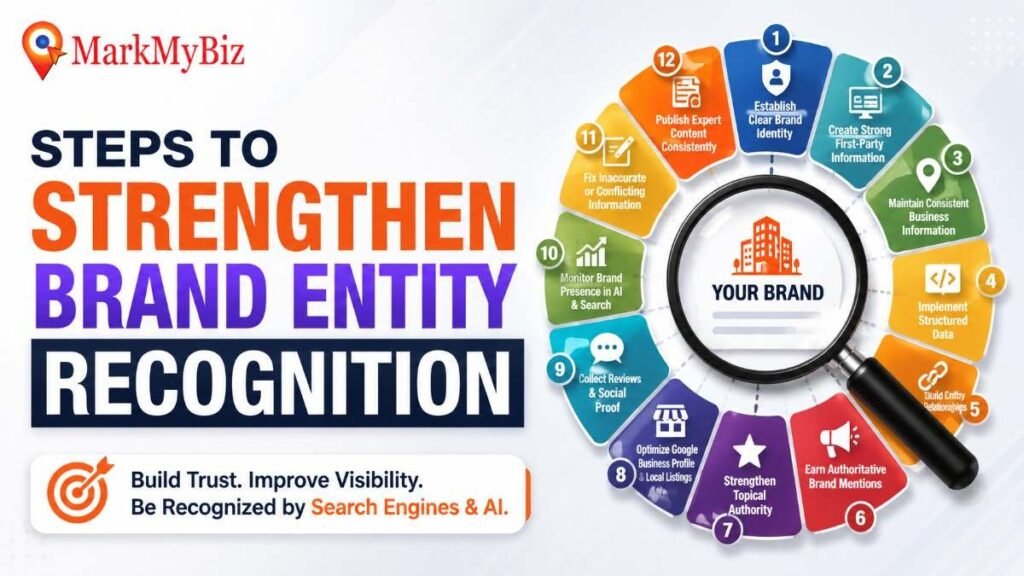
Practical Steps to Strengthen Brand Entity Recognition
- Settle on a clear identity first. One official business name, one primary category, one consistent description — decide these before touching anything else.
- Build out real first-party information. An About page that actually says something, service pages with substance, author or team bios if relevant.
- Audit for consistency. Name, address, phone number, description — check them across the website, Google Business Profile, and social platforms.
- Add Organization schema to the homepage or About page — accurate name, logo, URL, sameAs links.
- Layer in structured data by type — LocalBusiness, Person, Product, Article, whatever fits the business.
- Build entity relationships deliberately. Link out to, and get linked from, sources connected to your industry, location, and specialty.
- Earn mentions the slow way — genuine coverage, partnerships, expert contributions — rather than paid placements that add noise.
- Go deep on topical authority, not just isolated keywords. Cover a subject area properly.
- Keep profiles consistent across whatever platforms matter for your industry, including a properly optimized Google Business Profile for location-based businesses.
- Check how you’re currently represented — search the business name directly, including in AI tools, and see what comes back.
- Fix what’s wrong when you find it. Old directory listings are the usual offender.
- Keep publishing. One-time optimization fades faster than an ongoing content practice does.
Honestly, the biggest wins here rarely come from one clever technical fix. They come from cleaning up years of small inconsistencies — an old business name still floating around somewhere, a phone number that changed three years ago, a description that stopped matching the business a while back.
Common Mistakes Businesses Make With Brand Entity SEO
- Letting business information drift out of sync across the website, directories, and social platforms
- Over-optimizing — stuffing entity names into content where they don’t naturally belong
- Keyword stuffing instead of just writing naturally
- Fake or incentivized reviews, which tend to backfire once discovered
- Low-quality directory submissions that add noise, not credibility
- Backlinks built purely for SEO with no real relevance behind them
- Duplicate business profiles, especially on Google Business Profile or industry directories
- Incorrect or misleading schema, which breaks Google’s guidelines and can trigger manual action
- Fabricated author credentials or claims that don’t survive a second look
- Statistics or performance claims presented as fact with nothing backing them up
- Generic AI-written content with no real expertise behind it
- Expecting AI citations after one round of changes
- Focusing entirely on owned properties and ignoring third-party reputation
The Future of Generative AI Search and Brand Visibility
Search behavior is clearly moving toward Google AI Overviews, conversational search, and queries that mix text, images, and voice. Entity-based retrieval — answering based on things a system actually understands, rather than strings it happens to match — underlies most of this shift, whatever the front end looks like: AI Mode, a chatbot, a voice assistant.
It’s reasonable to expect brands with clearer, better-connected entity signals to have an edge as this continues. It’s not reasonable to expect a formula that guarantees AI citations — these systems are proprietary and keep changing in ways nobody outside the companies building them fully sees. The businesses that do well here tend to treat it as an ongoing habit — monitor, correct, build — rather than a project with an end date.
Key Takeaways
- A brand entity is how systems represent a business internally — not the same thing as a brand mention.
- Search engines build entity understanding by crawling, extracting, and reconciling information across sources.
- Generative AI draws on training data, retrieval, structured signals, and prompt context — and this differs by system.
- Entity relationships give both kinds of systems the context to understand a brand correctly.
- Consistency across a website, business profiles, and third-party mentions makes machine interpretation much easier.
- Structured data helps machines read a page accurately. It doesn’t guarantee rankings or AI citations.
- Strong Entity SEO builds on traditional SEO — it doesn’t replace it.
- No technique guarantees AI visibility, but a consistent, well-documented entity is far easier for any system to represent correctly.
Conclusion
SEO is increasingly rewarding businesses that build a clear, consistent, well-connected digital identity — not just the ones targeting the right keywords. As more discovery shifts to AI-generated answers, the brands that are easiest to describe accurately are the ones most likely to get described at all. That means treating the website, structured data, business profiles, and third-party mentions as one connected system, not a pile of separate tasks.
For businesses that want help auditing and strengthening that system — from the technical structured data work to a properly optimized Google Business Profile and consistent content — that’s the kind of foundational work MarkMyBiz’s SEO services covers, alongside broader website development support for getting the technical pieces right.
FAQs
How does AI recognize a brand?
Generative AI systems combine what they learned during training with, in many cases, live retrieval from the web. They’re looking for consistent, well-documented information — a clear business description, structured data, mentions from sources they trust — to build confidence about what a brand is and whether it’s relevant to a given question.
What is a brand entity in SEO?
It’s the structured, real-world representation of a business inside a search engine’s or AI system’s knowledge systems — name, category, location, and relationships to other entities — as opposed to just the keywords used to describe it.
How do search engines recognize brands?
By crawling and indexing content, pulling out likely entities, and reconciling them against other sources — business profiles, structured data, third-party references — to build a confident internal record of the business.
Does schema markup help AI understand a brand?
Yes, in that it gives machines an explicit description rather than one they have to infer from visible text. It supports disambiguation. It doesn’t, by itself, guarantee rankings or AI citations.
How can a business improve its AI search visibility?
Keep business information consistent everywhere, get structured data right, earn genuine mentions from relevant sources, and publish content that actually demonstrates expertise — as an ongoing practice, not a one-time project.
Do brand mentions influence AI search results?
They can, especially from topically relevant, trustworthy sources. Not every mention helps, though — low-quality or spammy ones add little and can occasionally hurt more than help.
Is Entity SEO important for Generative Engine Optimization?
Yes. GEO depends on AI systems being able to identify, trust, and cite a source in the first place. Entity SEO — consistent information, structured data, clear relationships — is largely what makes that possible.
Resources:
- Google Search Central — Organization Structured Data: Organization Structured Data Documentation
- Google Search Central — General Structured Data Guidelines: General Structured Data Guidelines
- Google Search Central — Introduction to Structured Data Markup: Introduction to Structured Data Markup
- Google — Introducing the Knowledge Graph: Things, Not Strings: Introducing the Knowledge Graph: Things, Not Strings
- Wikipedia — Generative Engine Optimization: Generative Engine Optimization