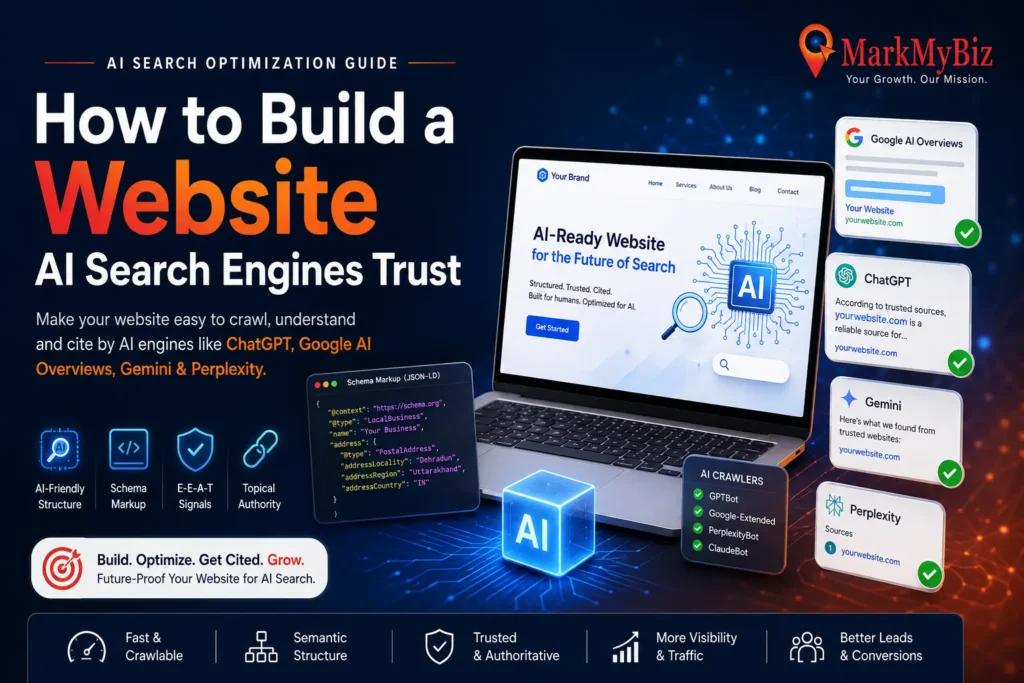
If you want your business to show up in ChatGPT answers, Google AI Overviews, Gemini summaries, and Perplexity citations, you need a website for AI search, not just a website for traditional rankings. AI search engines reward sites that are structured, factual, entity-rich, and easy to verify. This guide, brought to you by MarkMyBiz, walks small business owners through exactly how to optimize a website for AI search engines, step by step, with practical, EEAT-driven strategies you can implement today.
Quick Answer: What Makes a Website AI-Trustworthy?
Definition: An AI-trustworthy website is a site whose content is clear, factual, well-structured, properly attributed, and technically accessible to AI crawlers, allowing generative engines like ChatGPT, Gemini, and Google AI Overviews to confidently extract, summarize, and cite its information.
In short, AI search engines trust websites that combine strong E-E-A-T signals (Experience, Expertise, Authoritativeness, Trustworthiness) with semantic structure, schema markup, and consistent factual accuracy across the web.
Why AI Search Optimization Is Different From Traditional SEO
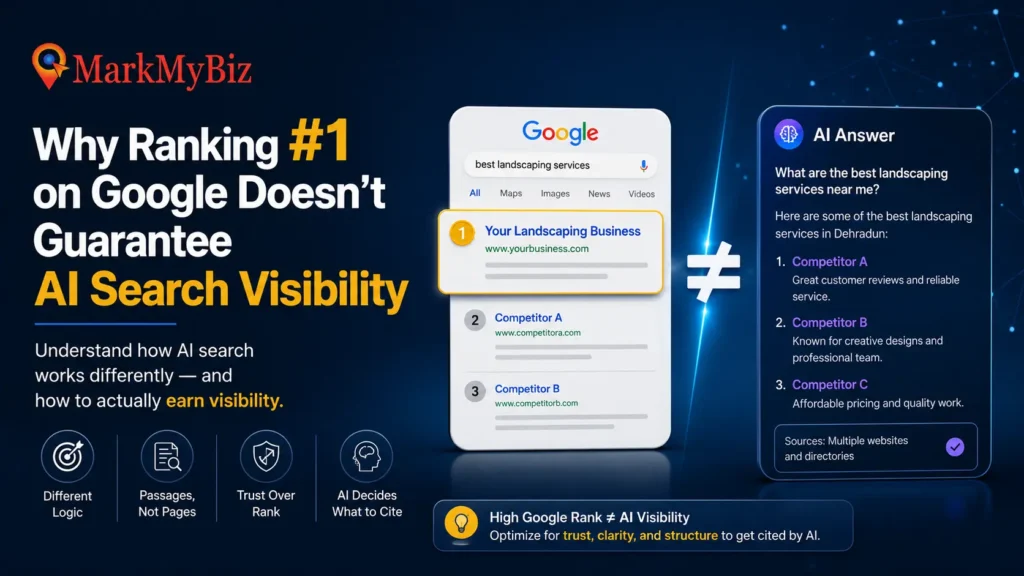
Traditional SEO focuses on ranking a page in a list of ten blue links. AI search optimization focuses on becoming the source an AI model chooses to summarize, paraphrase, or cite in a direct answer. This shift changes what ‘optimization’ means.
Traditional SEO vs. AI Search Optimization
| Factor | Traditional SEO | AI Search Optimization |
| Primary goal | Rank in top 10 results | Be cited or summarized in AI answers |
| Content format | Keyword-optimized articles | Structured, entity-based, quotable content |
| Key signal | Backlinks and keyword density | E-E-A-T, schema markup, factual consistency |
| User interaction | User clicks through to site | AI extracts answer, may or may not link back |
| Success metric | Rankings and click-through rate | Citation frequency, brand mentions, referral traffic |
Summary
AI search optimization expands traditional SEO by adding a new layer: making your website easy for large language models to read, verify, and quote accurately. A strong website for AI search satisfies both human readers and machine summarizers.
The 5 Foundations of an AI-Friendly Website
Before diving into tactics, it helps to understand the foundational pillars that determine whether AI search engines trust a website. MarkMyBiz applies these five pillars across every AI-ready website development project.
1. Technical Accessibility for AI Crawlers
AI systems such as GPTBot, Google-Extended, and PerplexityBot need unrestricted, fast access to your content. If your robots.txt blocks these crawlers, or your site relies heavily on JavaScript rendering without server-side rendering, AI engines may never see your content at all.
- Allow recognized AI crawlers in robots.txt unless you have a specific reason to block them.
- Use server-side rendering or static HTML for critical content.
- Maintain fast load times (under 2.5 seconds LCP) since slow sites are crawled less frequently.
- Submit an updated XML sitemap and keep it error-free in Google Search Console.
2. Clear Semantic Structure
Semantic SEO means organizing content so both humans and machines understand the relationships between topics, questions, and answers. A logical heading hierarchy (H1, H2, H3, H4) helps AI models map your page’s structure and extract the right section for a given query.
- One H1 per page that clearly states the main topic.
- H2s for major subtopics, H3s and H4s for supporting details.
- Short, self-contained paragraphs that answer one question each.
- Definition-style sentences near the top of each section.
3. Entity-Based Content and Schema Markup
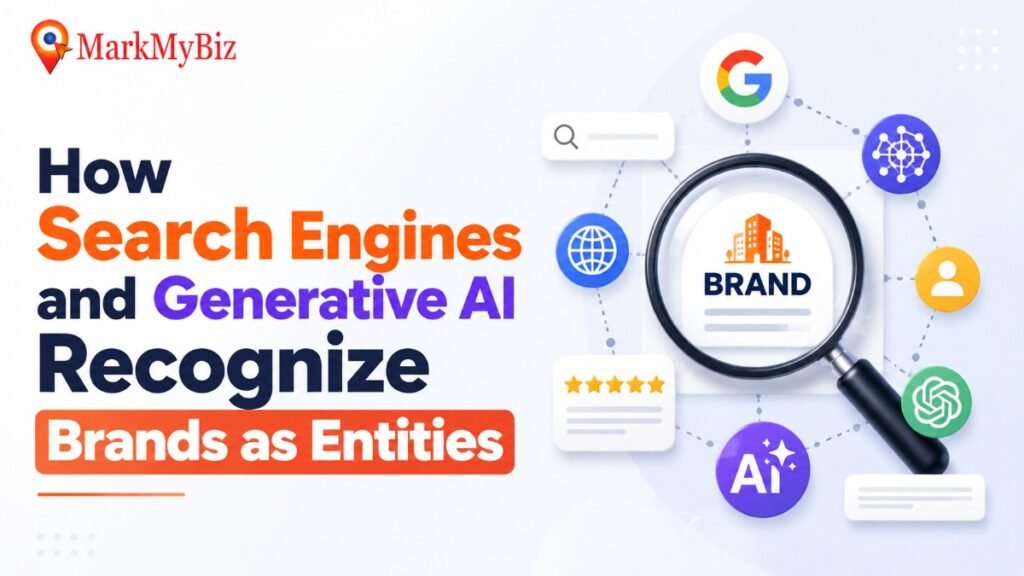
AI search engines think in entities, people, places, organizations, products, and concepts, and the relationships between them. Structured data (JSON-LD schema) explicitly tells AI systems what your business is, what it offers, and how it connects to other known entities.
- Implement Organization, LocalBusiness, Article, FAQPage, and Product schema where relevant.
- Use consistent business name, address, and phone (NAP) across your site and directories.
- Link internally between related entities, services, locations, and topic clusters.
4. Demonstrated E-E-A-T
Experience, Expertise, Authoritativeness, and Trustworthiness remain Google’s foundational quality framework, and AI Overviews inherit these signals when selecting sources. AI models are trained to favor content that demonstrates real-world experience and verifiable expertise over generic, AI-generated filler.
- Author bios with credentials and links to professional profiles.
- Original case studies, data, and first-hand examples.
- Citations to authoritative external sources.
- Transparent contact information, privacy policy, and business details.
5. Consistency and Freshness Across the Web
AI models cross-reference multiple sources before trusting a claim. If your business information is inconsistent across your website, Google Business Profile, directories, and social profiles, AI systems may flag your content as less reliable.
- Audit and standardize your business name, services, and location data across all platforms.
- Update key pages regularly with current information, pricing, and statistics.
- Refresh publish dates and content when material changes occur.
Summary
A website AI search engines trust is technically accessible, semantically structured, entity-rich with schema markup, backed by strong E-E-A-T signals, and consistent across the web. These five foundations form the backbone of every AI optimized website design project at MarkMyBiz.
Step-by-Step: How to Optimize a Website for AI Search
Below is a practical roadmap small business owners can follow to turn an existing website into an AI-friendly website, or to plan a new AI-ready website development project from scratch.
Step 1: Audit Your Current Website for AI Readiness
Start by reviewing your robots.txt, sitemap, page speed, and existing schema markup. Identify pages that already rank well and check whether they appear in AI Overviews or get cited by ChatGPT when you ask relevant questions.
- Run a technical SEO audit (crawlability, indexability, Core Web Vitals).
- Check robots.txt for AI crawler permissions (GPTBot, Google-Extended, PerplexityBot, ClaudeBot).
- Test sample queries in ChatGPT, Gemini, and Perplexity to see if your brand appears.
- Audit existing schema markup using Google’s Rich Results Test.
Step 2: Restructure Content Around Questions and Entities
Rewrite key pages so each section answers a specific question in a self-contained way. This format mirrors how AI Overviews and chat-based assistants extract answers, a concise definition or direct answer followed by supporting detail.
- Open each section with a one or two sentence direct answer.
- Follow with supporting context, examples, or data.
- Use bullet points and numbered lists for processes and comparisons.
- Add a brief summary after each major section.
Step 3: Implement Structured Data (Schema Markup)
Schema markup is one of the strongest signals for AI search engine optimization because it removes ambiguity. Instead of an AI model guessing what your page is about, schema explicitly defines it.
| Schema Type | Purpose | Best Used On |
| Organization | Defines your business entity, logo, and social profiles | Homepage, About page |
| LocalBusiness | Defines location, hours, and service area | Contact and location pages |
| FAQPage | Marks up question-and-answer content for direct extraction | FAQ sections, service pages |
| Article / BlogPosting | Identifies authorship, publish date, and topic | Blog posts and guides |
| Service / Product | Describes offerings with pricing and availability | Service and product pages |
Step 4: Strengthen E-E-A-T Signals Site-Wide
Add detailed author bios, link to credible sources, and showcase real client results. AI models, like human reviewers, are trained to discount thin, generic, or unattributed content in favor of material that demonstrates genuine expertise and first-hand experience.
- Create or update an About page with team credentials and business history.
- Publish case studies with measurable results.
- Add testimonials and reviews with schema markup.
- Cite authoritative sources (industry studies, .gov or .edu data) where relevant.
Step 5: Build Topical Authority With Internal Linking
AI search engines assess whether a website covers a topic comprehensively, not just whether a single page mentions a keyword. Building a cluster of interlinked pages around your core services signals topical authority and helps AI models understand the full scope of your expertise.
- Create a pillar page for your core service (e.g., AI-ready website development services).
- Link out to supporting pages covering related subtopics.
- Use descriptive, keyword-rich anchor text for internal links.
Step 6: Monitor AI Visibility and Iterate
AI search optimization is ongoing. Regularly test how your brand and content appear across ChatGPT, Gemini, Perplexity, and Google AI Overviews, and refine pages that are not being cited.
- Track brand mentions in AI-generated answers monthly.
- Update statistics, dates, and examples to keep content current.
- Expand FAQ sections based on real customer questions.
Summary
Optimizing a website for AI search follows a repeatable process: audit, restructure for direct answers, add schema markup, strengthen E-E-A-T, build topical clusters, and continuously monitor AI visibility. This is the same framework MarkMyBiz uses in its AI optimized website design engagements.
Real-World Example: Turning a Local Service Site Into an AI-Cited Source
Consider a small HVAC company whose website previously consisted of generic service pages with no FAQs, no schema, and inconsistent business information across directories. After restructuring the site around clear question-and-answer sections, adding LocalBusiness and FAQPage schema, and standardizing NAP data across Google Business Profile and local directories, the company began appearing in AI Overview answers for queries like ‘how often should I replace my HVAC filter’ and ‘average cost of AC repair in [city]’.
This example illustrates a broader pattern: AI search engines favor businesses that answer specific, local, and practical questions clearly, then back those answers with consistent, verifiable business information.
Common Mistakes That Make AI Search Engines Distrust a Website
Many small business websites unintentionally signal low trust to AI systems. Avoid these common pitfalls when working on AI search engine optimization.
- Blocking AI crawlers entirely in robots.txt without understanding the tradeoff.
- Publishing thin, generic content with no original insight or data.
- Inconsistent business name, address, or phone number across the web.
- Missing or broken schema markup.
- No author attribution or credentials on expert content.
- Outdated statistics, prices, or business hours.
- Overly promotional language with no factual substance.
Summary
Most trust issues stem from inconsistency, thin content, and missing structured data, not from a single technical flaw. Fixing these issues is often the fastest way to improve a website’s standing with AI search engines.
Why Work With a Professional Website Development Company
Implementing technical SEO, schema markup, semantic content structure, and ongoing AI visibility monitoring requires coordinated expertise across development, content, and SEO strategy. A professional website development company like MarkMyBiz combines these disciplines into a single, AI-ready website development service, helping small businesses avoid the trial-and-error approach and implement proven frameworks from day one.
Whether you need website development for AI search optimization on an existing site or a full AI-ready website development services engagement for a new build, the goal remains the same: a site that humans enjoy using and that AI search engines can confidently read, understand, and cite.
People Also Ask: Key Questions About AI Search Optimization
Does AI search optimization replace traditional SEO?
No. AI search optimization builds on traditional SEO. Technical SEO, page speed, mobile-friendliness, and quality backlinks remain foundational. AI search optimization adds structured data, entity clarity, and direct-answer formatting on top of that foundation.
How long does it take to see results from AI search optimization?
Most businesses begin seeing improved AI visibility within 4 to 12 weeks of implementing schema markup, restructured content, and consistent business information, though timelines vary based on site size, competition, and crawl frequency.
Can a small business compete with large brands in AI search results?
Yes. AI search engines often prioritize specific, locally relevant, and well-structured answers over generic large-brand content, particularly for local and service-based queries. A well-optimized small business site can outperform larger competitors for niche, location-specific questions.
Conclusion: Build a Website AI Search Engines Can Trust
Building a website AI search engines trust is no longer optional for small businesses that want visibility in ChatGPT, Gemini, Google AI Overviews, and Perplexity. By focusing on technical accessibility, semantic structure, entity-based content, schema markup, and strong E-E-A-T signals, you create a site that serves both human visitors and AI systems effectively.
MarkMyBiz specializes in AI-ready website development services and AI optimized website design for small businesses ready to take the next step in AI search engine optimization.
Ready to make your website AI-search ready? Contact MarkMyBiz today for a free AI search readiness audit and discover exactly what is holding your site back from appearing in AI-generated answers.
7. FAQs
What is a website for AI search?
A website for AI search is a site built or optimized so that AI-driven search engines and assistants, such as ChatGPT, Gemini, Perplexity, and Google AI Overviews, can easily crawl, understand, and cite its content in generated answers.
What is AI search optimization?
AI search optimization is the process of structuring content, technical infrastructure, and schema markup so that generative AI systems can accurately extract and reference information from a website.
How is an AI-friendly website different from a regular website?
An AI-friendly website prioritizes clear structure, direct-answer formatting, schema markup, and consistent factual information, in addition to standard SEO best practices like speed and mobile usability.
Why should I optimize my website for AI search engines?
Optimizing for AI search increases the likelihood that your business appears in AI-generated answers, which is becoming a major source of traffic, brand awareness, and lead generation as users increasingly rely on AI assistants for research and recommendations.
What schema markup is most important for AI search engine optimization?
Organization, LocalBusiness, FAQPage, and Article schema are among the most important types for AI search engine optimization, as they define your business identity, location, common questions, and content authorship.
Do I need to block or allow AI crawlers like GPTBot?
In most cases, allowing recognized AI crawlers such as GPTBot, Google-Extended, and PerplexityBot in your robots.txt file increases the chance of being included in AI-generated answers, unless you have specific business reasons to restrict access.
How does E-E-A-T affect AI search visibility?
E-E-A-T, Experience, Expertise, Authoritativeness, and Trustworthiness, helps AI systems determine which sources are reliable. Sites demonstrating strong E-E-A-T signals are more likely to be selected as sources for AI-generated answers.
Can MarkMyBiz help with AI-ready website development services?
Yes. MarkMyBiz provides AI-ready website development services, including AI optimized website design, schema markup implementation, and ongoing AI search engine optimization for small businesses.
How often should I update my website for AI search optimization?
Regularly updating content, statistics, and business information, ideally every few months for key pages, helps maintain accuracy and signals freshness to both traditional search engines and AI systems.
Will AI search optimization help with local SEO too?
Yes. Many AI search optimization practices, such as consistent NAP data, LocalBusiness schema, and location-specific FAQ content, directly overlap with and strengthen local SEO performance.