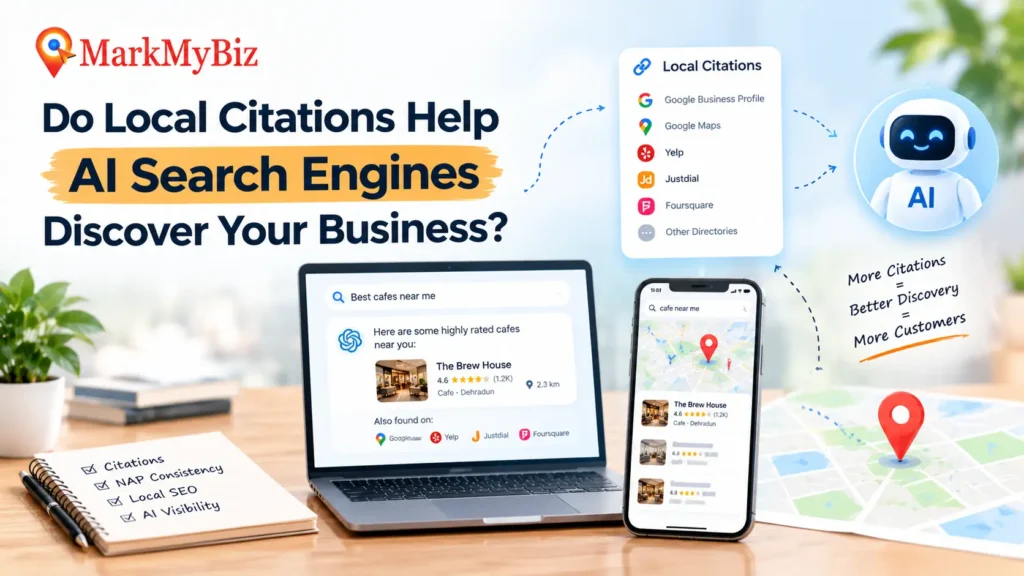
Short answer: yes, but not in the way most agencies sell them.
Local citations help AI search engines confirm your business is real and that its details are correct. They rarely get you recommended on their own. Understanding that difference is worth more than another five hundred directory submissions.
This matters because the way people find local businesses has genuinely changed. A growing share of customers now ask ChatGPT, Gemini or Perplexity for a recommendation instead of scrolling a map. And AI is far pickier than Google ever was. Where a business might appear in Google’s local pack a third of the time, the equivalent rate inside AI recommendations is a small fraction of that. If you want to be in that fraction, it helps to know exactly what job local citations are doing and what job they aren’t.
| About This Guide: Written by the MarkMyBiz team — a Dehradun-based digital marketing and local SEO agency that audits citations, profiles and AI visibility for businesses across Uttarakhand and North India. Based on published 2026 citation research and what we see in live client accounts. |
First, “Citation” Means Two Different Things
Most of the confusion around local citations and AI search comes from one word carrying two meanings.
In local SEO, a citation is a mention of your business name, address and phone number on another website. A Justdial listing. A Sulekha page. Your entry in a trade association directory. That’s what people mean by local SEO citations.
In AI search, a citation is a source link the model shows underneath its answer. That’s an AI search citation, and it’s usually a website, a review platform, a news article or a community thread.
These are not the same thing. Your Justdial listing almost never appears as the clickable source under a ChatGPT answer. So when someone asks whether citations for local SEO help with AI, the honest answer depends entirely on which meaning they’re using. One is a verification signal working quietly in the background. The other is a visible source link.
Agencies selling bulk citation packages tend to blur the two on purpose. Ask any vendor quoting you a number of listings which of the two they’re actually promising, and the answer usually tells you everything about whether the package is worth buying.
What the Data Actually Says
Here’s where it gets interesting, because the research is genuinely mixed.
Several 2026 studies found that AI engines pointing at local businesses send most of their citations to the business’s own website, with directories making up a surprisingly small share. Other research found that businesses referenced consistently across Google, review sites and industry directories were noticeably more likely to be surfaced across multiple AI platforms.
Both can be true at once, and that’s the key insight. Directories are rarely the source an AI shows. They are frequently part of what convinces the AI your business exists, is legitimate, and matches the details it’s about to state out loud.
One more thing worth knowing before you plan anything: the source mix changes fast. One tracked study watched ChatGPT’s local citation sources swing dramatically within a few weeks, with community content dominating one month and business websites dominating the next. Any strategy built entirely around one platform’s current preferences is building on sand. Fundamentals are the safer bet.
What Local Citations Actually Do for AI Search
Think of it as corroboration rather than promotion.
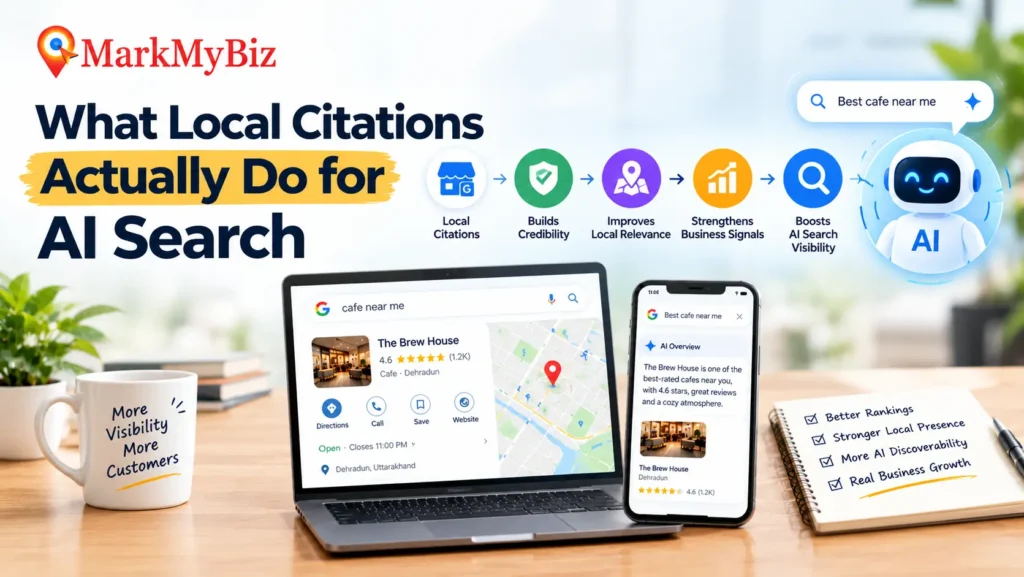
When an AI system prepares to recommend a local business, it’s assembling facts from several places at once: your website, your Google Business Profile, review platforms, directories and whatever else it can retrieve. If those sources agree, the model states your details confidently. If they conflict — one address on your site, a different one on Justdial, an old number on a listing nobody updated — it has a problem.
Conflicting facts don’t usually produce a wrong answer. They produce no answer. The model quietly names a competitor whose details line up cleanly instead. That’s the real cost of messy listings, and it’s invisible, which is why so few businesses catch it.
So the function of local citations for AI search is narrow but genuine:
- They confirm your business exists as a real entity at a real address
- They reinforce your category, so the model knows what you actually do
- They maintain NAP consistency across the web, which is the single most practical thing you control here
- They occasionally feed structured local data into platforms the AI does pull from directly
That’s it. That’s the job. The effect of local citations on SEO and business visibility is real but indirect — they raise the floor of what a machine can say about you with confidence, and they do it quietly, in the background, without ever showing up in an answer.
Where Local Citations Stop Helping
The returns drop off a cliff faster than most people expect.
Fifteen accurate listings on platforms that matter in your industry and city will do essentially everything two hundred listings would. Past that point you’re not adding signal, you’re adding surface area for inconsistency — because every extra listing is one more place your phone number can go stale.
Low-quality directories are worse than neutral. Spun listings on sites nobody visits don’t carry authority with AI systems any more than they do with Google, and they create exactly the kind of conflicting data that gets you skipped.
And no volume of citations substitutes for the things that actually earn a recommendation. Local citations are a floor, not a ceiling. They get you considered. They don’t get you chosen.
What Moves AI Search Rankings More Than Citations
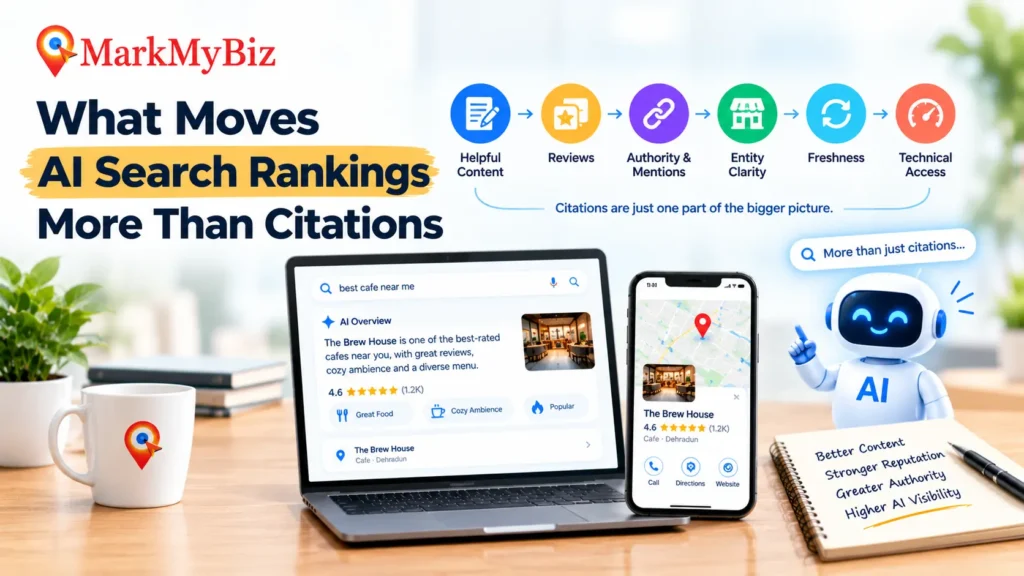
If you have a limited budget, spend it in roughly this order.
Google Business Profile optimization comes first, without much competition. For local queries, your profile is the densest source of structured truth about your business anywhere on the web — categories, services, hours, photos, reviews. Most local AI answers lean on it heavily. GBP optimization is the highest-return work available to almost any local business, and it’s free.
Your own website is second, and this surprises people. Multiple studies of local AI citations found the business’s own site was the most-cited source across major engines. A thin homepage with no service detail and no location page costs you the citation outright. Give every service and every area a real page with real information on it.
Reviews sit third. Volume, recency and how you respond all feed both Google and the review platforms AI systems read. A steady trickle beats a burst.
Third-party mentions where you aren’t the author come fourth. Local news coverage, a genuine roundup post, an industry association page, a community thread where someone recommends you. This is the layer most businesses skip entirely, and it’s the one that separates “listed” from “recommended” in local AI search. A directory entry tells a model you exist. Someone else describing you well tells it you’re worth naming.
Citations That Matter for Indian Businesses
Generic citation advice written for American businesses lists Yelp and Thumbtack. That’s not your market.
For local SEO for businesses in India, the corroboration layer looks more like Google Business Profile first, then Justdial, IndiaMART, Sulekha, and whatever vertical platforms your category actually uses — Practo for clinics, an education portal for institutes, a real estate platform for property firms. Add your Bing Places listing, since some AI tools still lean on Bing’s index for retrieval.
Two India-specific traps worth flagging. First, address formatting: the same location written as “Rajpur Road,” “Rajpur Rd” and “Rajpur Marg” across three listings is three different facts to a machine. Pick one exact format and use it everywhere. Second, phone numbers: listings with an old landline, a personal mobile and a business line scattered across platforms are extremely common here, and they’re a quiet visibility killer.
How to Audit Your Citations in an Afternoon
You don’t need a tool for the first pass.
Search your business name in quotes and note every platform that comes back. Open each one and compare the name, address and phone against your Google Business Profile, exactly — not approximately. Fix or claim what’s wrong, and delete or update duplicates rather than leaving them.
Then test the outcome directly. Ask ChatGPT, Gemini, Perplexity and Google’s AI mode a question a customer would actually ask, like “reliable dental clinic in Dehradun with evening hours.” Note who gets named and what’s said about you if you appear at all. Being described inaccurately is its own problem, and it usually traces back to a listing you’d forgotten about.
Repeat monthly. AI answers shift between sessions and regions, so one bad result proves nothing — direction over several months tells you far more than any single answer will.
Frequently Asked Questions
Do local citations directly improve AI search rankings?
Not directly. They improve the consistency and confidence of the data AI systems use to describe your business, which improves your odds of being named. The bigger movers are your Google Business Profile, your own website, reviews and third-party mentions.
How many local citations does a small business need?
Far fewer than most packages sell. Roughly ten to twenty accurate, relevant listings on platforms that matter in your city and category covers the corroboration job. Accuracy beats volume every time.
Does NAP consistency still matter in the AI era?
More than before. Traditional search could tolerate small mismatches. AI systems checking several sources before making a recommendation handle conflicting facts by skipping the business entirely.
The Practical Takeaway
Local citations are maintenance work, not growth work. Get them accurate, keep them accurate, then stop and put your effort where recommendations are actually won: your profile, your site, your reviews, and getting talked about by people who don’t work for you.
If you’d rather not spend your afternoons cross-checking directory listings, MarkMyBiz works as a local SEO agency in Dehradun handling exactly this — citation audits and cleanup, GBP optimization, and AI search optimization services that track what ChatGPT, Gemini and Perplexity are saying about your business month to month.
Curious what AI tools currently say about you? Send us your business name and city, and we’ll run the questions and show you the answers.